Official source
The Qur'an
Quran.com presentation of the Qur’an with English translation support, used for mainstream Islamic references.
The Qur’an, Quran.com, accessed June 16, 2026.
Open sourceIslam
Begin with Islam's own claims about Allah, the Qur'an, Muhammad, and the denial of shirk, then compare those claims with the apostolic witness to Christ.

Common objections and counters
These are recurring objections raised from within this worldview, paired with concise Christian counters and links to the full reference entries.
Counter
Textual variants are real, but the New Testament message has not disappeared; Christians can distinguish variants from total loss and can ask where, when, and by whom the alleged lost Injil was replaced.
Start by granting what is true, because it costs nothing and buys credibility. There are hundreds of thousands of variants across the manuscripts. A handful of well-known passages, including the Comma Johanneum (1 John 5:7), the longer ending of Mark, and the woman caught in adultery (John 7:53–8:11), are very probably not original. We do not possess the autographs of any New Testament book.
Christian scholarship says all of this out loud. It is printed in the footnotes of ordinary study Bibles. The question is what follows. “The wording of some verses is debated” and “the message Jesus gave has been lost and replaced” are completely different claims, and only the first is supported by the evidence.
Classical Muslim thought never settled on one version of the charge:
These need different evidence and lead to different places. Ibn Hazm pressed the harder, textual version; many others (and much of the Qur’an’s own language) fit the softer one. This matters because the Qur’an addresses Jews and Christians who possess their scriptures and tells them to judge by what is in them (Surah 5:43, 47; 10:94). A book that tells the People of the Gospel to consult the Gospel in front of them undercuts the claim that the Gospel had already been destroyed.
The strongest internal pressure is not merely that the Qur’an says God once gave the Torah and the Gospel. It speaks to Jews and Christians in Muhammad’s own setting as people who still have Scriptures with public authority. Surah 2:89, 2:91, 2:101, and 4:47 describe the Qur’an as confirming what is “with” the People of the Book. Surah 5:43 says Jews have the Torah with God’s judgment in it. Surah 5:47 tells the People of the Gospel to judge by what God revealed in it. Surah 5:68 says the People of the Book have nothing to stand on unless they uphold the Torah, the Gospel, and what was revealed to them.
That does not require Christians to claim every biblical manuscript is word-for-word identical. The claim is narrower and stronger: the Torah and Gospel texts available before, during, and after Muhammad are substantially the same public texts we can inspect today, and they already teach the crucifixion, resurrection, divine Sonship, and apostolic gospel Islam rejects. If those Scriptures were trustworthy enough for the Qur’an to confirm and appeal to, Islam must explain why the Qur’an contradicts them. If they were already textually corrupted beyond use, Islam must explain why the Qur’an still sends Jews and Christians back to them.
Engage Ehrman fairly, because his data is real and his conclusion is overstated. The vast majority of variants are spelling slips, word-order differences, and obvious nonsense readings that change nothing a translation would show. The reason there are so many variants is that there are so many manuscripts, and that abundance is exactly what lets scholars triangulate the original and expose the few late additions. A corruption that hides itself leaves no trail. This one is catalogued in the apparatus of every critical edition.
Even Ehrman concedes the decisive point: no essential Christian doctrine is left in jeopardy by the textual variants. Jesus as God, the resurrection, and the gospel do not stand on the disputed verses. Metzger’s lifetime of work pointed the same way; the New Testament text is recoverable to a very high degree of confidence. A discipline that is public, self-correcting, and verifiable is the opposite of a secret tampering.
When the objection comes from a Muslim critic, do not let the standard shift mid-conversation. The Islamic tradition itself reports a collection and standardization history. In Sahih al-Bukhari, Abu Bakr commissions Zayd ibn Thabit to collect the Qur’an after deaths among the reciters at Yamamah, and Zayd gathers it from written materials and memory. Later, Uthman commissions a standard codex for the provinces and orders other Qur’anic materials burned. Muslim apologists can argue that this preserved the Qur’an, but they cannot then say that human collection, scribal transmission, or a post-prophetic standardization process automatically disqualifies the Bible.
Nor is it accurate to say that Islam has no textual-form question at all. Mainstream Islam recognizes canonical qira’at, or readings. Many differences are recitational, but some are meaningful enough to appear in translation; Bridges’ Translation of the Ten Qira’at explicitly marks the subset of qira’at variation that affects meaning in English. That does not prove Islam false by itself. It does show that the simplistic contrast “the Qur’an has one unchanged text, while the Bible has versions” is not careful enough to bear the argument.
The fair comparison is this: Christianity has a manuscript tradition with many visible variants and enough surviving evidence to evaluate them. Islam has an early standardizing tradition that reduced visible manuscript diversity and later canonized multiple readings. Both traditions need to answer historical questions. The New Testament should not be dismissed by a standard that would create harder questions for the Qur’an.
Press the positive question back. If the real Injil was a single book handed to Jesus and then swapped out for the four canonical Gospels, that event has to have happened somewhere, at some time, by someone, and it should have left a seam. It did not. Before Islam, Christianity was already spread from Spain to India, in Greek, Latin, Syriac, and Coptic, with thousands of manuscripts and a flood of quotations in the church fathers, all converging on the same fourfold Gospel. No competing “original Injil” survives, no record of its suppression exists, and no geography escaped the alleged edit in unison.
Meanwhile the core message is traceable to the very beginning: the creed Paul cites in 1 Corinthians 15:3–8, that Christ died for our sins, was buried, and was raised, is widely dated by scholars to within a few years of the crucifixion. The honest verdict is not that the message vanished, but that it was reliably transmitted and is the gospel the apostles finally delivered.
The most useful question is often not “Can Christians answer every charge at once?” but “What exactly does the Muslim claim the Qur’an is identifying?” Surah 7:157 speaks of Muhammad being found written with the People of the Book in the Torah and the Injil. Surah 5:46-47 says the Gospel given to Jesus contained guidance and light and tells the People of the Gospel to judge by what God revealed in it. Surah 10:94 can even direct Muhammad, if in doubt, to those who had read Scripture before him. Surah 6:115 and 18:27 also say that God’s words cannot be changed, which raises the burden for any claim that God’s earlier revelation became unavailable as a usable witness.
Those texts create a burden for the lost-Injil claim. If the Qur’an is pointing its hearers to a Gospel that Christians possessed in Muhammad’s day, what was that written Gospel? Who wrote it? When was it written? Where did it circulate? Why is there no trace of it among the Christians the Qur’an addresses? If the answer is “we do not know,” then the claim that Matthew, Mark, Luke, and John cannot be that Gospel is not an argument from evidence. It is an escape from the evidence.
Bottom line
Variants are real and openly catalogued; the loss of the message is a different claim entirely, and the evidence runs against it. The abundance of manuscripts is what lets scholars recover the text and flag the few late additions, even critics grant no doctrine is at stake. The Qur’an’s own appeals to what was with Jews and Christians in Muhammad’s day sharpen the question: what written Gospel did Christians possess if not the one preserved in apostolic witness?
Counter
Islam can speak movingly about mercy and repentance, but assurance remains unstable if final acceptance rests on a balance of deeds and Allah’s discretionary mercy. The gospel grounds assurance in Christ’s finished work, so obedience becomes grateful fruit rather than the basis of acquittal.
Do not caricature Islam as a crude scoreboard where Muslims think they can buy heaven. Many Muslims speak seriously of mercy, repentance, humility, and dependence on Allah. The Qur’an repeatedly calls people to repent and hope in mercy. Hadith material also speaks of intercession and Allah’s forgiveness.
The Christian should grant that this is not emotional nothingness. Many Muslims sincerely love God as they understand him and fear final judgment. The question is narrower: where does final assurance rest?
If final acceptance depends on deeds, repentance, sincerity, and Allah’s mercy at judgment, the believer can hope, but cannot rest. How sincere is sincere enough? How many good deeds weigh enough? What if hidden motives poison the act? What if Allah withholds mercy? A system can speak often of mercy and still leave the conscience without a finished ground of peace.
This matters because guilt is not only a feeling. If God is holy, sin creates real liability. A vague appeal to mercy does not explain how justice is satisfied. The Christian answer is not that God ignores sin, but that Christ bears judgment and gives righteousness to those who trust him.
The gospel gives assurance because its foundation is not the believer’s spiritual performance. “By grace you have been saved through faith… not by works” does not mean works are worthless. It means works are not the ground of acquittal. Christ is.
That is why Christian assurance is not arrogance. It is not confidence that “I am good enough.” It is confidence that Jesus is a sufficient Savior. The believer’s obedience matters as fruit and evidence, but it does not carry the weight of final justification.
The strongest Muslim concern is that assurance will produce carelessness: if Jesus paid for sins, why not keep sinning? The New Testament rejects that conclusion. Real faith joins a person to Christ, brings repentance, and produces a new life by the Spirit. Someone who uses grace as permission to sin is not taking grace seriously; he is denying what grace is for.
But this does not move assurance back onto merit. Good works show life; they do not purchase pardon. The difference matters. In Islam, the believer may hope the final balance and mercy will be enough. In the gospel, the believer rests in Christ and then learns to obey from gratitude, not terror.
This question is often personal. A Muslim seeker may wonder not only about their own salvation, but about parents, grandparents, and a whole community. Do not answer that pain with a cold formula. Christians can say what the gospel says about Christ as the only Savior while entrusting individual people to God’s perfect justice and mercy.
The invitation is not to despise family or culture. It is to come to Christ, who gives rest to burdened sinners and a sure hope that does not depend on the shifting measurement of one’s own deeds.
Bottom line
Islam offers hope in mercy, repentance, deeds, and intercession, but it cannot give settled assurance while the final ground remains the believer’s performance plus Allah’s discretionary mercy. The gospel gives a different kind of peace: Christ has finished the saving work, and believers rest in him. Obedience still matters, but as grateful fruit, not as the basis of final acquittal.
Counter
The New Testament’s high Christology is already present in first-century sources, where Jesus is confessed with the names, works, worship, and identity that belong to God while remaining distinct from the Father.
The Qur’an rejects claims that associate others with Allah and presents Jesus as Messiah, messenger, and servant rather than as God. Christians should not blur that disagreement. The real question is whether the Qur’an’s later portrait corrects the New Testament, or whether the earliest apostolic witness already identifies Jesus within the unique identity of Israel’s God.
John, Paul, and Hebrews do not honor Jesus as a prophet only. They place him on the Creator side of the Creator-creature distinction and show divine honor directed to him. John says the Word was with God and was God, then says all things were made through him. Paul writes Jesus into Israel’s one-God confession in 1 Corinthians 8:6. Hebrews has the Father address the Son as God and command the angels to worship him.
The answer is not limited to one formula in John’s Gospel. In Mark, Jesus forgives sins by his own authority, knows what his opponents are reasoning in their hearts, stills the sea in language that echoes the LORD’s deliverance in Psalm 107, and places himself as the beloved son sent after the prophets in the vineyard parable. These are implicit claims, but they are not weak claims. They place Jesus in roles Scripture reserves for God.
That is not a late move away from monotheism. It is first-century Jewish believers rereading everything around the crucified and risen Jesus while still refusing idolatry.
A person can reject the New Testament portrait. But if the portrait is granted, “Jesus was only a good moral teacher” will not hold. He forgives sins by his own authority, claims unique relation to the Father, speaks of existing before Abraham, and accepts Thomas’s confession, “My Lord and my God.”
This is where Liar, Lunatic, or Lord helps. It is not a slogan to win the conversation quickly. It presses the unstable middle position that admires Jesus while refusing to answer his claims.
The strongest objection says the high claims were placed on Jesus after the fact. That is why the answer must connect Christology to history. The earliest Christian worship of Jesus, the resurrection proclamation in Jerusalem, and the New Testament’s public witness all have to be explained. If the resurrection is God’s vindication of Jesus, then it vindicates the claimant, not a generic prophet.
Pre-Nicene evidence pushes the same direction. Ignatius of Antioch speaks of Jesus Christ as God near the beginning of the second century, and Pliny the Younger reports that Christians sang hymns to Christ as to a god decades before the great fourth-century councils. Later creeds clarified vocabulary; they did not create Christian worship of Jesus from nothing.
So the Christian answer is not “Jesus said one magic sentence.” It is a cumulative case: the texts present him with divine names, works, honor, and worship; the apostolic church proclaimed this early; and the resurrection is God’s verdict on the one they proclaimed.
Bottom line
The New Testament does not leave Jesus as a prophet later made into God. It presents him from the beginning as distinct from the Father and yet sharing the divine identity through names, works, worship, and resurrection vindication. A later source that denies that claim cannot be treated as the earliest Christian witness.
Counter
If Muslim only means one who submits to God, Christians agree that Jesus submitted perfectly to the Father. But if Islam means the religion of Muhammad, the Qur’an, and the sunnah, Jesus lived before it and taught claims about himself, the Father, the cross, and the gospel that Islam later denies.
The word “Muslim” can be used in two different ways. If it means simply “one who submits to God,” then Christians can gladly say Jesus submitted perfectly to the Father. He obeyed, prayed, trusted, and fulfilled his mission without sin.
But that is not enough to prove Islam. If “Muslim” means a follower of the Qur’an, Muhammad, and Islamic teaching as a religious system, then the statement becomes historically anachronistic. Jesus lived six centuries before Muhammad. The real question is not whether Jesus submitted to God, but what Jesus taught and whether Muhammad’s later message agrees with it.
It is possible to find surface similarities between Jesus and Muslim practice: Jesus prayed, fasted, worshiped the one God, and lived with reverence. But gestures do not settle identity. A person can prostrate and still be wrong about who Jesus is. A person can avoid pork and still reject the gospel Jesus entrusted to his apostles.
The source question matters. If a Muslim appeals to the Bible to show that Jesus prayed or lived a certain way, then the same Bible must be allowed to speak when Jesus forgives sins, receives worship, calls God his Father, predicts his death and resurrection, and sends his disciples to proclaim him. If the Bible is removed, Islam has very little concrete material about Jesus’ daily teaching and practice.
The New Testament does not present Jesus as a generic submitter whose message can be replaced by a later prophet. He is the Son who uniquely reveals the Father, the Word made flesh, the one Thomas confesses as “my Lord and my God,” and the crucified and risen Messiah who sends witnesses to the nations.
That is why the disagreement is not solved by saying Jesus was monotheistic. Christians are monotheists too. The disputed questions are sharper: Did Jesus die and rise? Is he the eternal Son? Did he send the Spirit to guide the apostolic witness? Is the gospel final, or can a later message deny the cross and redefine Jesus? On those questions, Islam and the New Testament do not say the same thing.
Jesus did not leave a Qur’an, but he did leave authorized witnesses. He taught publicly, chose apostles, promised the Holy Spirit would bring his words to remembrance, and commissioned them to bear witness. The Christian claim is not that later church preference outranks Jesus; it is that the apostolic witness is how Jesus made his teaching known.
So the fair invitation is simple: read Jesus in the sources that preserve his words and deeds, and let his full identity speak. A Jesus reduced to “a prophet who submitted” is smaller than the Jesus of the Gospels.
Bottom line
Jesus submitted perfectly to God, but that does not make him a follower of Muhammad’s later religion. The decisive question is not whether Jesus prayed or honored the one God; Christians agree he did. The question is whether Islam agrees with Jesus’ own witness about his identity, cross, resurrection, and gospel. On those central claims, the New Testament Jesus is not the Jesus Islam requires.
Counter
Qur’an 4:157 denies the crucifixion, but the death of Jesus by crucifixion is embedded in the earliest Christian proclamation and is also reflected by non-Christian ancient witnesses.
Qur’an 4:157 says they did not kill or crucify Jesus, but that it was made to appear so to them. Later tafsir commonly develops substitution explanations, while some modern discussions explore minority readings of the verse.
Paul, Acts, Tacitus, Josephus, later Jewish tradition, and critical scholars across theological lines treat Jesus’ crucifixion as a fact requiring explanation. A denial must explain why both Christian and non-Christian streams remember Jesus’ execution.
Counter
Deuteronomy 18 and the Paraclete passages fit the biblical context of Israel’s prophetic hope and the Holy Spirit’s mission; they do not require Muhammad, and later prooftexts should be tested in context.
Moses speaks of a prophet from among Israel’s brothers and also gives tests for false prophecy. Acts applies the passage to Jesus, and the wider chapter does not authorize a message that overturns the apostolic gospel.
Jesus says the Advocate is the Holy Spirit, sent by the Father in Jesus’ name to teach and remind the disciples of Jesus’ words. That description does not fit a later human messenger outside the apostolic circle.
Popular arguments from words such as periklutos or from Song of Songs depend on strained readings. They should not carry more weight than the direct context of the passages.
Counter
Islam itself asks Muslims to regard Muhammad as an excellent pattern, so the moral question cannot be brushed aside. Christians should state Islamic sources carefully, avoid mockery, and compare the claimed model with Jesus’ sinless life and the moral character of God.
Do not answer this by grabbing the most inflammatory quote and trying to shock the Muslim into agreement. The Muslim claim is theological: Muhammad is Allah’s messenger and the model of obedience, not simply an admired figure. Qur’an 33:21 is therefore central. If Muhammad is Allah’s final prophet, then his life carries moral and religious authority.
That also means the moral question is legitimate. A prophet who is presented as the best pattern can be asked about the pattern he sets. The Christian does not need to pretend neutrality about Muhammad, but he does need to be accurate, restrained, and willing to cite Islamic sources rather than internet slogans.
A common escape is to say that moral criticism of Muhammad comes from Western values, not from God. Sometimes that warning is fair; Christians should not confuse late-modern social assumptions with divine law. But the deeper issue cannot be dismissed so easily. Muslims themselves praise Muhammad as merciful, just, truthful, and noble. Those are moral categories, not bare commands.
If good and evil mean only “whatever Allah declares,” then moral praise becomes thin: one could not meaningfully say Allah is good, only that Allah does what Allah does. The biblical view is different. Goodness is grounded in God’s unchanging character, and human conscience really can recognize moral pressure because people are made by God. That is why the question is not “does this offend my culture?” but “does this reflect the perfectly good God?”
Some Islamic sources create real moral pressure. Sahih reports place Aisha’s marriage to Muhammad at six and consummation at nine. Qur’an 4:34 gives husbands a disciplinary recourse commonly translated as striking or beating after admonition and separation in bed. Qur’an 65:4 discusses waiting periods for those who have not menstruated, and Qur’an 33:49 says there is no waiting period where a woman has not been touched. Muslim interpreters may qualify, contextualize, or dispute how these texts apply, but the texts are not imaginary.
The Christian should not make Aisha the object of shame or use sexualized insult as an argument. The question is about Muhammad as a model. If the best human example authorizes patterns that Christians believe are incompatible with the moral character of God, that is a serious theological objection, not mere cultural distaste.
The Christian contrast is not “Muhammad versus twenty-first-century Western ethics.” It is Muhammad versus Jesus. The New Testament presents Jesus as tempted yet without sin, gentle with the vulnerable, truthful before enemies, and self-giving even at the cross. He teaches moral law and embodies the character of God in human life.
That is why the question matters evangelistically. If a Muslim is already troubled by moral tensions in Islamic sources, do not leave them with disgust alone. Point them to Christ: the one whose holiness does not crush sinners but calls them to rest, repentance, and forgiveness.
Bottom line
Islam’s claim about Muhammad is moral as well as historical: he is offered as the excellent pattern. That makes his example a fair subject of scrutiny. Christians should cite Islamic sources accurately, avoid mockery, and ask whether the pattern fits the character of the perfectly good God. Then move the comparison to Jesus, the sinless one who commands righteousness, embodies it, and gives rest to sinners.
Counter
The Qur’an’s challenge deserves to be stated accurately, but literary excellence is not the same kind of public historical test as the resurrection of Jesus or the apostolic witness to the gospel.
Do not begin by belittling the Qur’an. Its Arabic is genuinely powerful; its cadence has shaped a civilization’s literature and moves hundreds of millions in worship and memory. The experience Muslims describe, being arrested by the recitation, is sincere and worth taking seriously. A Christian who sneers at it has already lost the person and, worse, has been ungracious about something they love.
We can also grant the structure of the claim. The Qur’an does challenge opponents to produce “a sūrah the like thereof,” and many Muslims connect that challenge to i’jaz, its inimitability. A hadith in Sahih al-Bukhari records Muhammad contrasting his gift with that of earlier prophets: their miracles were occasional signs, but what he was given was revelation itself. So the argument is not simply “the Qur’an is beautiful to us.” It is a definite claim that the book’s literary quality is a standing, public miracle. State it that strongly before answering it.
The question that does the most work is not “is the Qur’an eloquent?” but “what would literary excellence, even if granted in full, actually prove?” Three features make aesthetic inimitability a weak foundation for a truth claim:
None of this mocks the Qur’an. It simply notes that overwhelming beauty and divine origin are different claims, and the first does not by itself deliver the second.
Christianity does not finally rest its case on the literary superiority of the Bible. It rests on something a person of any language can investigate: a claim about what happened in history. The earliest gospel summary stakes everything on a datable, public, in-principle-falsifiable event, that Christ died, was buried, and was raised, and was seen by named witnesses, many still living when the claim was published (see the resurrection witnesses).
Paul makes the wager explicit: if Christ has not been raised, the Christian message is empty and the preachers are liars. That is a falsifiable bet, not an appeal to taste. The truth of the gospel turns on an event in public time, accessible to historical inquiry regardless of one’s mother tongue, not on whether a reader finds the prose beautiful.
Even granting inimitability outright, it would show literary uniqueness, not that the content is true. Scripture’s tests for a claimed revelation are not stylistic at all. They ask whether the message is true and whether it coheres with what God has already revealed (see public revelation and prophetic tests). Moses warns Israel to reject a prophet whose message turns them from the LORD even if he performs a sign. Paul says that if anyone, “even an angel from heaven,” preaches a different gospel, let him be accursed.
That is the decisive point. A messenger may be eloquent, even unmatched, and still fail the test if the message overturns what God has revealed. Eloquence is not a credential for doctrine. So the honest question is not “which book is more beautiful?” but “what is true, and how would we know?”
Bottom line
Literary beauty, however real, is the wrong kind of evidence for a public truth claim: it is judged by taste, bound to one language, and scored by criteria internal to the tradition. The gospel rests not on style but on a datable, public, in-principle-falsifiable event: Jesus crucified and raised, attested by named witnesses. And Scripture’s own test of any message is truth and fidelity to prior revelation, not eloquence. Ask not “which book is more beautiful?” but “what happened, and how would we know?”
Counter
The Trinity is not three gods. It is the Christian confession that the one God is Father, Son, and Holy Spirit, grounded in the Bible’s one-God confession and its divine treatment of the Son and Spirit.
Start by honoring what is right in the objection. Christians do not hold that there are three gods, and we share the horror of idolatry that drives tawhid. The first commandment and the Shema; “Hear, O Israel: the LORD our God, the LORD is one”; are ours too. The instinct that God is one, unique, and unshareable in his glory is not a Muslim instinct we must overcome; it is a biblical instinct we confess.
We can also grant that the Qur’an rejects a real error. When it pictures Christians taking “Jesus and his mother as two gods besides Allah,” it denies something no church council ever taught. Mary is not a person of the Godhead; “Son” does not mean God took a wife and begot a child. On those points the Christian says amen, that is not the Trinity, and we reject it as firmly as any Muslim does.
The charge of shirk assumes the Trinity is addition: God plus two partners. It is not. The doctrine is a single claim about who the one God is, that the one divine being exists eternally as three persons, Father, Son, and Holy Spirit. One what (being, nature, will), three whos (persons). The number is not “one and three” in the same respect, so there is no contradiction, just as a thing can be one being without being one person. This is laid out at the Trinity is monotheism.
“Son” is the key word to clarify, because it carries the heaviest offense. In Scripture it never names a biological event. It names an eternal relation; the Son is “begotten, not made,” eternally from the Father as light is from a flame, with no consort and no beginning. Indeed the Qur’an’s own protest, “how could He have a son when He has no consort,” targets a physical sonship the church also denies. So the disagreement is not about whether God procreated. It is about whether the one God eternally exists as Father and Son.
The Christian answer should not rest on the claim that the Qur’an misread us. That is true but thin. The real work is showing why the one-God confession of Israel itself opens onto Father, Son, and Spirit.
Larry Hurtado shows this was no late, Greek overlay: the first Jewish believers were already worshiping Jesus alongside the Father within a fiercely monotheistic frame. The Trinity is the church’s summary of that data, not an importation onto it.
Shirk means giving a creature the unique honors of the Creator. So the charge that the Trinity is shirk already assumes the thing actually in dispute, that Jesus is a creature. If Jesus is a creature, then worshiping him would indeed be idolatry, and we would deserve the rebuke. But Christians do not worship a creature raised to God’s rank; we confess that the Son belongs on the Creator side of the line, included within the one divine identity from eternity.
That reframes the conversation honestly. The question between Muslim and Christian is not “one God or three?”; both of us say one. Nor is it “may a creature be worshiped?”; both of us say no. The single question on which everything turns is: who is Jesus? Settle that, and the charge of shirk either dissolves or sticks. So the most fruitful move is not to defend the arithmetic of the Trinity but to press, gently and from the sources, the identity of Christ. Nabeel Qureshi, who came to this question from inside Islam, frames the choice in just these terms.
Bottom line
The charge of shirk lands only if Jesus is a creature given the honors of God. Christians do not add partners to God; we confess that the one God of Israel is eternally Father, Son, and Holy Spirit, and that the Son belongs on the Creator side of the line. Both faiths insist there is one God and that no creature may be worshiped. The real question is not “one or three?” but “who is Jesus?”, and that is where the conversation should go.
Islam confesses Allah’s absolute oneness, Muhammad as Allah’s messenger, and the Qur’an as revelation. Fair answers should quote the Qur’an and major hadith or tafsir sources before critique.
The Islamic dilemma asks whether Islam can hold together the Qur’an’s positive treatment of earlier revelation with its denial of the Bible’s central message about Jesus. The Qur’an speaks of the Torah and the Gospel as revelation from God (3:3-4), tells the People of the Gospel to judge by what God revealed in it (5:47), and can direct Muhammad to ask those who had read Scripture before him (10:94), yet it rejects the crucifixion and the New Testament’s witness to Christ.
That creates the dilemma: if the Torah and Gospel available in Muhammad’s day were trustworthy, Islam must explain why the Qur’an contradicts them on the cross, the Son, and the gospel. If they had already been textually corrupted, Islam must explain why the Qur’an still points Jews and Christians back to those scriptures and where the alleged replacement happened in the public manuscript record. Press this carefully, not as a slogan, and connect it to the Bible is corrupted and the reliability of the New Testament.
Apply the same historical standard to both: manuscripts, variants, collection, and recoverability.
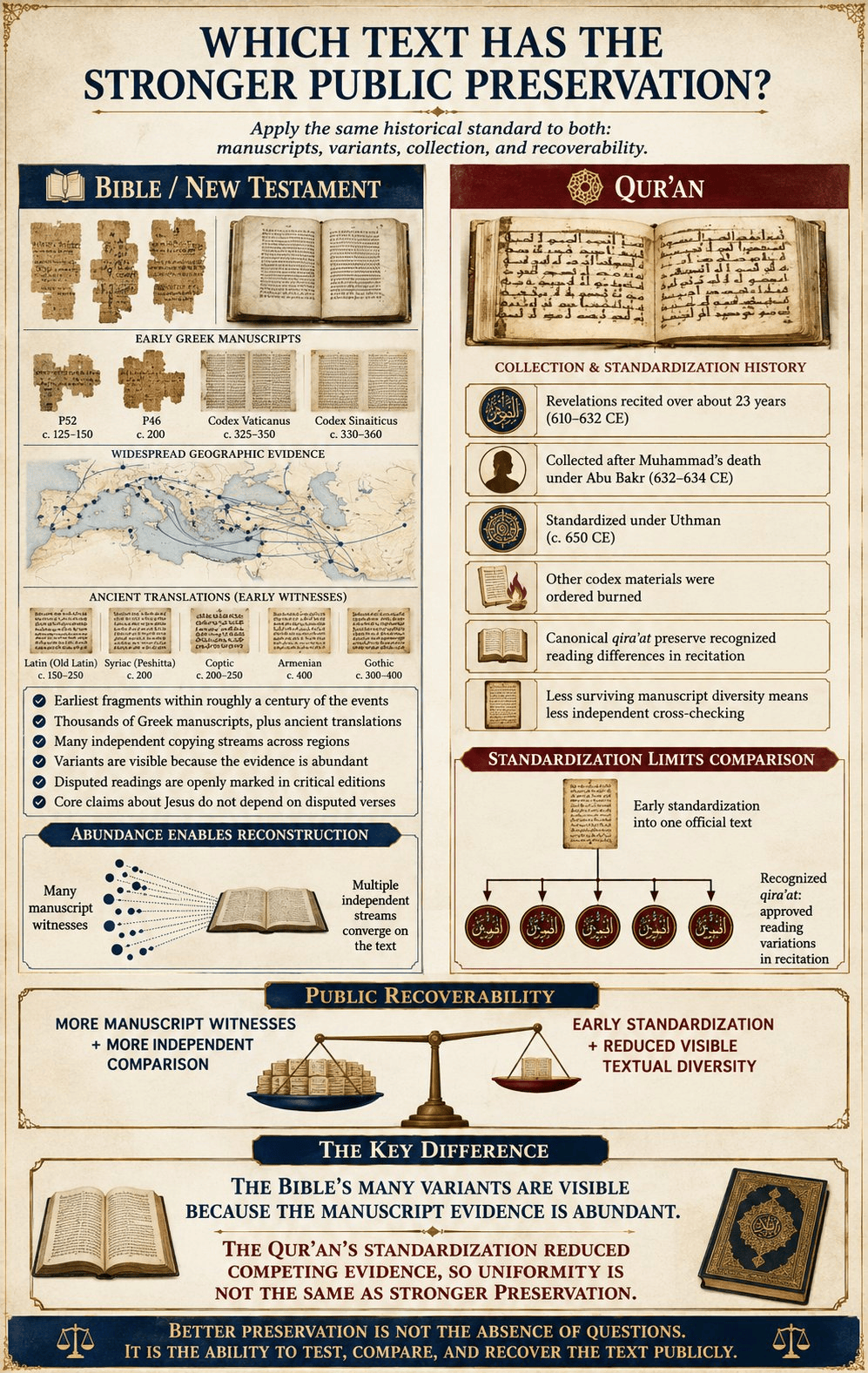
Bible and New Testament
Many manuscript witnesses, early translations, and geographically distributed copying streams expose variants publicly.
The abundance of evidence makes variants visible, but it also lets the text be compared and recovered.
Qur'an
Islamic tradition includes post-Muhammad collection and Uthman’s standardization of provincial copies.
Early standardization can produce visible uniformity while reducing surviving evidence for independent comparison.
Better preservation is not merely the absence of visible questions; it is the ability to test, compare, and recover the text publicly.
The central disagreement is not first cultural or political. It concerns whether Jesus was crucified and raised, and whether the New Testament’s worship of Jesus belongs inside biblical monotheism.
Tahrif arguments can mean textual alteration or misreading; Qur’an 4:157 can be read with later substitution tafsir or other minority readings; and i’jaz arguments should not be treated as the same kind of public historical test as the resurrection.
Official source
Quran.com presentation of the Qur’an with English translation support, used for mainstream Islamic references.
The Qur’an, Quran.com, accessed June 16, 2026.
Open sourcePrimary source
A major Sunni hadith collection presented by Sunnah.com.
Sahih al-Bukhari, Sunnah.com, accessed June 16, 2026.
Open sourcePrimary source
A major Sunni hadith collection presented by Sunnah.com.
Sahih Muslim, Sunnah.com, accessed June 16, 2026.
Open sourceReference
Classical Sunni tafsir used to represent traditional interpretation of Qur’anic passages.
Ibn Kathir, Tafsir on Qur’an 4:157, Quran.com, accessed June 16, 2026.
Open sourceSecondary context
Christian apologetics treatment of Islam and Christianity by a former Muslim.
Nabeel Qureshi, No God but One: Allah or Jesus?, Zondervan, 2016.
Secondary context
Scholarly work on early divine-identity Christology and Jewish monotheism.
Richard Bauckham, Jesus and the God of Israel: God Crucified and Other Studies on the New Testament’s Christology of Divine Identity, Eerdmans, 2008.
Secondary context
Scholarly work on devotion to Jesus in earliest Christianity.
Larry W. Hurtado, Lord Jesus Christ: Devotion to Jesus in Earliest Christianity, Eerdmans, 2003.