Reference
BibleRef
BibleRef provides reference material for Scripture passages.
BibleRef, accessed June 16, 2026.
Open sourceArgument
The New Testament presents Jesus as personally distinct from the Father while sharing the names, works, worship, and identity that belong to the one God alone.
Christian confession that Jesus is God does not begin by adding a second god to Israel's God. It arises because the New Testament places Jesus inside the unique identity of the one Creator, treating him as the agent of creation, the bearer of the divine name, and the rightful recipient of worship, while still distinguishing him from the Father.
Visual summary
Concise visual summaries for teaching, discussion, and sharing.
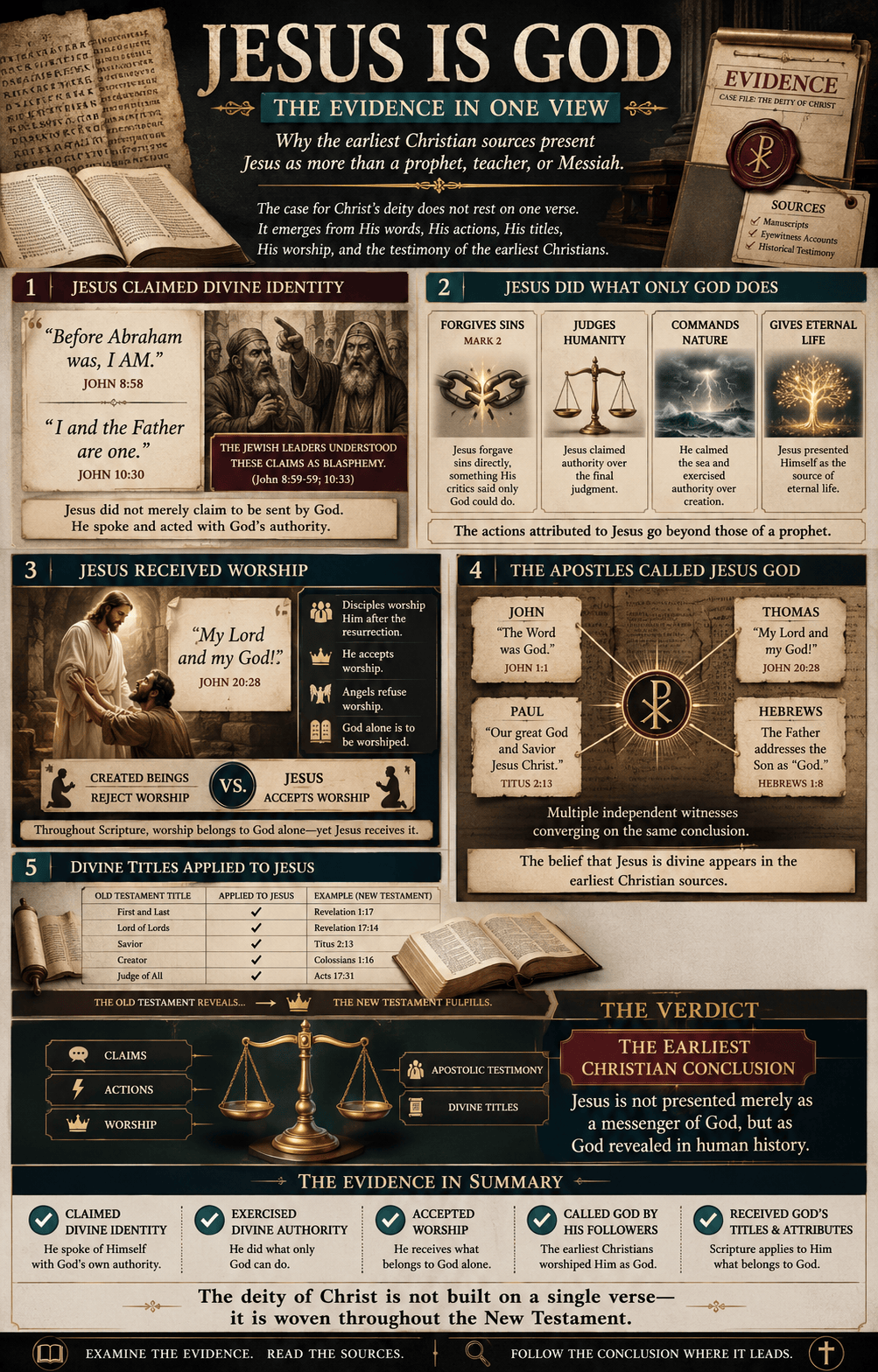
A one-page visual summary of Jesus' divine claims, divine works, received worship, apostolic testimony, divine titles, and the cumulative conclusion.
The decisive issue is not whether the word Trinity appears in a verse, or whether Jesus ever recites the sentence “I am God.” The question is whether the New Testament places Jesus within the unique identity of the one God of Israel; the God who alone created all things, who alone bears the divine name, and who alone is worshiped.
Richard Bauckham calls this a Christology of divine identity: the earliest Christians did not first define an abstract divine nature and then ask whether Jesus possessed it. They identified Jesus by what only God does and who only God is; creating and sustaining all things, ruling from the heavenly throne, bearing the name above every name, and they did this while remaining Jewish monotheists. Reading the texts this way keeps us from a fruitless hunt for a single proof verse and lets the whole pattern speak.
That also puts the familiar Liar, Lunatic, or Lord argument in its proper place. It is not a substitute for exegesis or history. It asks whether “great teacher but not Lord” still makes sense once the New Testament portrait of Jesus is actually in view.
John opens by saying the Word was with God and was God, then says all things were made through him, and finally that the Word became flesh as Jesus. The two clauses are deliberate. “With God” keeps the Word personally distinct from the Father; “was God” refuses to make him anything less than fully divine. Christian doctrine simply preserves both halves: the Son is not the Father, and the Son is not a creature.
Some translations render the last clause “the Word was a god,” a move examined in John 1:1 does not say “a god”. But the wider sentence settles the sense: the one through whom all things were made cannot himself be one of the made things. John 8:58 points the same direction, where Jesus says that before Abraham was born, “I am”; language that echoes the LORD’s own self-identification (“I am he”) in Isaiah, and which his hearers treat as a divine claim worth stoning him for.
The sharpest line in Jewish monotheism runs between the Creator and everything created. The New Testament repeatedly puts Jesus on the Creator side of it:
This is why “firstborn” and “image of the invisible God” cannot be read as “first creature.” The same passage that uses those words makes Jesus the source, not a product, of creation.
Do not let the conversation be narrowed to one modern sentence, as though Jesus had to say the exact words “I am God; worship me” before the evidence counts. The Synoptic Gospels often show his identity by what he does, how he speaks, and where he places himself in Israel’s story.
Mark gives several examples. Jesus calls twelve disciples, standing over the restored people of God rather than simply taking one tribal seat among them. In the vineyard parable, he distinguishes himself from the servants sent before him and identifies himself as the beloved son sent by the owner after the prophets. He knows what opponents are reasoning in their hearts, a knowledge Scripture reserves to God, and he stills the sea in a way that echoes Psalm 107, where the LORD quiets the storm and delivers those who cry to him.
None of these replaces the direct texts in John, Paul, Hebrews, and Revelation. They show that the divine-identity pattern is not limited to one Gospel or one proof verse.
Larry Hurtado documents that the worship of Jesus; prayer to him, hymns about him, calling on his name, baptizing into him; is present astonishingly early, among Jewish believers who would not bow to any creature, and not as a slow later development. That devotional pattern is itself evidence of how the first Christians understood him.
Scripture shows the same instinct. John says Thomas answered Jesus directly, “My Lord and my God.” This is not a stray exclamation into the air. When apostles or angels are wrongly treated as divine, they refuse the honor and redirect it to God; Herod is judged for receiving divine praise. Jesus does not correct Thomas. He receives the confession and commends the faith that sees him truly.
Revelation makes the same point in another register. Jesus calls himself “the First and the Last,” a title the LORD claims for himself in Isaiah, and the Lamb receives creation-wide worship with the One on the throne.
Several texts sharpen the same point from another angle. In Revelation 5, every creature in heaven, on earth, under the earth, and in the sea gives blessing, honor, glory, and might to the One on the throne and to the Lamb. The Lamb is not listed as one more creature joining the song. He receives the worship of the whole creation with God.
Jesus also asks the Father to glorify him with the glory he had with the Father before the world existed, while Isaiah says the LORD does not give his glory to another. John then says Isaiah saw Jesus’ glory when he quotes Isaiah’s temple vision. The apostolic writers are not embarrassed to speak this way because they are not giving divine honor to a creature. They are confessing the Son who shares the Father’s glory while remaining personally distinct from the Father.
Titus 2:13 and 2 Peter 1:1 compress the same confession into doxological language about Jesus Christ as God and Savior. The natural reading is strengthened by comparison with 2 Peter 1:11, where “Lord and Savior” plainly names one person, Jesus Christ. Grammar should not be oversold as a magic formula that ends every dispute, but in context the titles fit the wider pattern: Jesus receives the names, works, glory, worship, and saving role of the one God.
By this point, the argument should be read cumulatively. The New Testament does not merely say isolated exalted things about Jesus. It joins his claims, actions, worship, apostolic confession, and Old Testament titles into one pattern: Jesus is personally distinct from the Father, yet he receives what belongs to God alone.
The case for Christ’s deity is woven through the New Testament rather than resting on a single proof text.
Claims and actions
Jesus speaks with divine authority and does what Scripture attributes to God alone.
Worship and confession
Jesus receives worship and direct divine confession rather than redirecting that honor away from himself.
Titles and testimony
Apostolic writers apply divine names, roles, and Old Testament categories to Jesus while maintaining monotheism.
The conclusion is not built from one verse alone. It comes from the repeated New Testament pattern of giving Jesus God’s works, names, throne, glory, and worship.
The later creeds did not invent worship of Jesus. They gave careful vocabulary to a devotion already present in the church’s earliest life. Ignatius of Antioch, writing near the beginning of the second century, speaks of Jesus Christ as God while also distinguishing him from the Father. Pliny the Younger, a Roman governor hostile to Christian worship, reported around the same period that Christians gathered to sing to Christ as to a god.
That evidence does not replace the biblical case. It answers the historical claim that Jesus’ deity was a late fourth-century corruption. Before Nicaea, Christians were already worshiping Christ, and outsiders already recognized that worship as directed to him.
The strongest objection gathers the texts where Jesus looks subordinate: he says “the Father is greater than I,” he does not know the day or hour, he prays, he is “sent,” and he will be “subjected” to the Father. If he is God, how can any of this be true?
Two distinctions carry the weight:
Read this way, the subordination texts are not embarrassments to be explained away. They are precisely what you would expect if the eternal Son truly became one of us, and the same Gospels that record his prayers also record Thomas worshiping him and John calling him God. Related objections are handled at Jesus never claimed to be God and Jesus is Michael the archangel.
Bottom line
The case that Jesus is God is not built on a lone proof text or on the word Trinity. It is built on a consistent pattern: the New Testament gives Jesus the works, names, throne, and worship that belong to the one Creator, while still distinguishing him from the Father. The verses where he prays or defers fit a real incarnation and a real distinction of persons; they never reduce him to a creature. To meet Jesus in these pages is to meet the LORD made flesh.
Reference
BibleRef provides reference material for Scripture passages.
BibleRef, accessed June 16, 2026.
Open sourceSecondary context
Scholarly work on early divine-identity Christology and Jewish monotheism.
Richard Bauckham, Jesus and the God of Israel: God Crucified and Other Studies on the New Testament’s Christology of Divine Identity, Eerdmans, 2008.
Secondary context
Scholarly work on devotion to Jesus in earliest Christianity.
Larry W. Hurtado, Lord Jesus Christ: Devotion to Jesus in Earliest Christianity, Eerdmans, 2003.
Primary source
Early Christian witness to Jesus Christ as God and to pre-Nicene worship.
Ignatius of Antioch, Letter to the Ephesians 18.2; 20.2.
Primary source
Roman governor’s report that Christians sang hymns to Christ as to a god.
Pliny the Younger, Letters 10.96.
Secondary context
Video apologetics episode presenting four conversational cases for Christ’s deity from John 20, Titus 2, Jesus’ implicit claims, and early Christian worship.
Trent Horn, “My Four Favorite Ways to Prove Jesus is God,” The Counsel of Trent, YouTube, June 3, 2026, accessed June 18, 2026.
Open source