Official source
The Qur'an
Quran.com presentation of the Qur’an with English translation support, used for mainstream Islamic references.
The Qur’an, Quran.com, accessed June 16, 2026.
Open sourceObjection
Jesus was a prophet who never claimed to be God; Christians later made him God.
The New Testament’s high Christology is already present in first-century sources, where Jesus is confessed with the names, works, worship, and identity that belong to God while remaining distinct from the Father.
Visual summary
Concise visual summaries for teaching, discussion, and sharing.
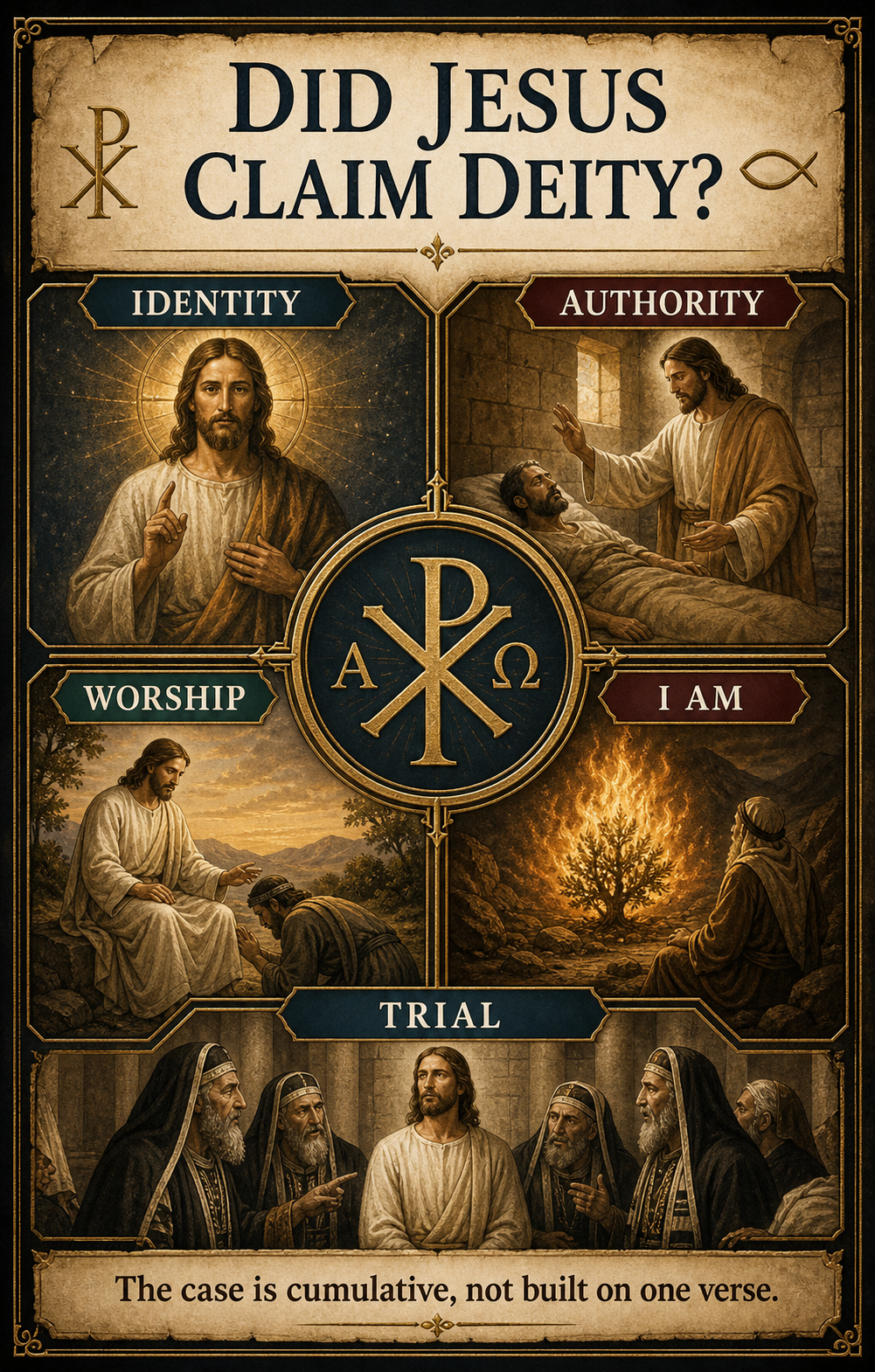
A visual summary of Jesus' identity, authority, worship, I AM claim, and trial testimony.
The Qur’an rejects claims that associate others with Allah and presents Jesus as Messiah, messenger, and servant rather than as God. Christians should not blur that disagreement. The real question is whether the Qur’an’s later portrait corrects the New Testament, or whether the earliest apostolic witness already identifies Jesus within the unique identity of Israel’s God.
John, Paul, and Hebrews do not honor Jesus as a prophet only. They place him on the Creator side of the Creator-creature distinction and show divine honor directed to him. John says the Word was with God and was God, then says all things were made through him. Paul writes Jesus into Israel’s one-God confession in 1 Corinthians 8:6. Hebrews has the Father address the Son as God and command the angels to worship him.
The answer is not limited to one formula in John’s Gospel. In Mark, Jesus forgives sins by his own authority, knows what his opponents are reasoning in their hearts, stills the sea in language that echoes the LORD’s deliverance in Psalm 107, and places himself as the beloved son sent after the prophets in the vineyard parable. These are implicit claims, but they are not weak claims. They place Jesus in roles Scripture reserves for God.
That is not a late move away from monotheism. It is first-century Jewish believers rereading everything around the crucified and risen Jesus while still refusing idolatry.
A person can reject the New Testament portrait. But if the portrait is granted, “Jesus was only a good moral teacher” will not hold. He forgives sins by his own authority, claims unique relation to the Father, speaks of existing before Abraham, and accepts Thomas’s confession, “My Lord and my God.”
This is where Liar, Lunatic, or Lord helps. It is not a slogan to win the conversation quickly. It presses the unstable middle position that admires Jesus while refusing to answer his claims.
The strongest objection says the high claims were placed on Jesus after the fact. That is why the answer must connect Christology to history. The earliest Christian worship of Jesus, the resurrection proclamation in Jerusalem, and the New Testament’s public witness all have to be explained. If the resurrection is God’s vindication of Jesus, then it vindicates the claimant, not a generic prophet.
Pre-Nicene evidence pushes the same direction. Ignatius of Antioch speaks of Jesus Christ as God near the beginning of the second century, and Pliny the Younger reports that Christians sang hymns to Christ as to a god decades before the great fourth-century councils. Later creeds clarified vocabulary; they did not create Christian worship of Jesus from nothing.
So the Christian answer is not “Jesus said one magic sentence.” It is a cumulative case: the texts present him with divine names, works, honor, and worship; the apostolic church proclaimed this early; and the resurrection is God’s verdict on the one they proclaimed.
Full rebuttal
Christian confession that Jesus is God does not begin by adding a second god to Israel’s God. It arises because the New Testament places Jesus inside the unique identity of the one Creator, treating him as the agent of creation, the bearer of the divine name, and the rightful recipient of worship, while still distinguishing him from the Father.
The decisive issue is not whether the word Trinity appears in a verse, or whether Jesus ever recites the sentence “I am God.” The question is whether the New Testament places Jesus within the unique identity of the one God of Israel; the God who alone created all things, who alone bears the divine name, and who alone is worshiped.
Richard Bauckham calls this a Christology of divine identity: the earliest Christians did not first define an abstract divine nature and then ask whether Jesus possessed it. They identified Jesus by what only God does and who only God is; creating and sustaining all things, ruling from the heavenly throne, bearing the name above every name, and they did this while remaining Jewish monotheists. Reading the texts this way keeps us from a fruitless hunt for a single proof verse and lets the whole pattern speak.
That also puts the familiar Liar, Lunatic, or Lord argument in its proper place. It is not a substitute for exegesis or history. It asks whether “great teacher but not Lord” still makes sense once the New Testament portrait of Jesus is actually in view.
John opens by saying the Word was with God and was God, then says all things were made through him, and finally that the Word became flesh as Jesus. The two clauses are deliberate. “With God” keeps the Word personally distinct from the Father; “was God” refuses to make him anything less than fully divine. Christian doctrine simply preserves both halves: the Son is not the Father, and the Son is not a creature.
Some translations render the last clause “the Word was a god,” a move examined in John 1:1 does not say “a god”. But the wider sentence settles the sense: the one through whom all things were made cannot himself be one of the made things. John 8:58 points the same direction, where Jesus says that before Abraham was born, “I am”; language that echoes the LORD’s own self-identification (“I am he”) in Isaiah, and which his hearers treat as a divine claim worth stoning him for.
The sharpest line in Jewish monotheism runs between the Creator and everything created. The New Testament repeatedly puts Jesus on the Creator side of it:
This is why “firstborn” and “image of the invisible God” cannot be read as “first creature.” The same passage that uses those words makes Jesus the source, not a product, of creation.
Do not let the conversation be narrowed to one modern sentence, as though Jesus had to say the exact words “I am God; worship me” before the evidence counts. The Synoptic Gospels often show his identity by what he does, how he speaks, and where he places himself in Israel’s story.
Mark gives several examples. Jesus calls twelve disciples, standing over the restored people of God rather than simply taking one tribal seat among them. In the vineyard parable, he distinguishes himself from the servants sent before him and identifies himself as the beloved son sent by the owner after the prophets. He knows what opponents are reasoning in their hearts, a knowledge Scripture reserves to God, and he stills the sea in a way that echoes Psalm 107, where the LORD quiets the storm and delivers those who cry to him.
None of these replaces the direct texts in John, Paul, Hebrews, and Revelation. They show that the divine-identity pattern is not limited to one Gospel or one proof verse.
Larry Hurtado documents that the worship of Jesus; prayer to him, hymns about him, calling on his name, baptizing into him; is present astonishingly early, among Jewish believers who would not bow to any creature, and not as a slow later development. That devotional pattern is itself evidence of how the first Christians understood him.
Scripture shows the same instinct. John says Thomas answered Jesus directly, “My Lord and my God.” This is not a stray exclamation into the air. When apostles or angels are wrongly treated as divine, they refuse the honor and redirect it to God; Herod is judged for receiving divine praise. Jesus does not correct Thomas. He receives the confession and commends the faith that sees him truly.
Revelation makes the same point in another register. Jesus calls himself “the First and the Last,” a title the LORD claims for himself in Isaiah, and the Lamb receives creation-wide worship with the One on the throne.
Several texts sharpen the same point from another angle. In Revelation 5, every creature in heaven, on earth, under the earth, and in the sea gives blessing, honor, glory, and might to the One on the throne and to the Lamb. The Lamb is not listed as one more creature joining the song. He receives the worship of the whole creation with God.
Jesus also asks the Father to glorify him with the glory he had with the Father before the world existed, while Isaiah says the LORD does not give his glory to another. John then says Isaiah saw Jesus’ glory when he quotes Isaiah’s temple vision. The apostolic writers are not embarrassed to speak this way because they are not giving divine honor to a creature. They are confessing the Son who shares the Father’s glory while remaining personally distinct from the Father.
Titus 2:13 and 2 Peter 1:1 compress the same confession into doxological language about Jesus Christ as God and Savior. The natural reading is strengthened by comparison with 2 Peter 1:11, where “Lord and Savior” plainly names one person, Jesus Christ. Grammar should not be oversold as a magic formula that ends every dispute, but in context the titles fit the wider pattern: Jesus receives the names, works, glory, worship, and saving role of the one God.
By this point, the argument should be read cumulatively. The New Testament does not merely say isolated exalted things about Jesus. It joins his claims, actions, worship, apostolic confession, and Old Testament titles into one pattern: Jesus is personally distinct from the Father, yet he receives what belongs to God alone.
The case for Christ’s deity is woven through the New Testament rather than resting on a single proof text.
Claims and actions
Jesus speaks with divine authority and does what Scripture attributes to God alone.
Worship and confession
Jesus receives worship and direct divine confession rather than redirecting that honor away from himself.
Titles and testimony
Apostolic writers apply divine names, roles, and Old Testament categories to Jesus while maintaining monotheism.
The conclusion is not built from one verse alone. It comes from the repeated New Testament pattern of giving Jesus God’s works, names, throne, glory, and worship.
The later creeds did not invent worship of Jesus. They gave careful vocabulary to a devotion already present in the church’s earliest life. Ignatius of Antioch, writing near the beginning of the second century, speaks of Jesus Christ as God while also distinguishing him from the Father. Pliny the Younger, a Roman governor hostile to Christian worship, reported around the same period that Christians gathered to sing to Christ as to a god.
That evidence does not replace the biblical case. It answers the historical claim that Jesus’ deity was a late fourth-century corruption. Before Nicaea, Christians were already worshiping Christ, and outsiders already recognized that worship as directed to him.
The strongest objection gathers the texts where Jesus looks subordinate: he says “the Father is greater than I,” he does not know the day or hour, he prays, he is “sent,” and he will be “subjected” to the Father. If he is God, how can any of this be true?
Two distinctions carry the weight:
Read this way, the subordination texts are not embarrassments to be explained away. They are precisely what you would expect if the eternal Son truly became one of us, and the same Gospels that record his prayers also record Thomas worshiping him and John calling him God. Related objections are handled at Jesus never claimed to be God and Jesus is Michael the archangel.
Bottom line
The case that Jesus is God is not built on a lone proof text or on the word Trinity. It is built on a consistent pattern: the New Testament gives Jesus the works, names, throne, and worship that belong to the one Creator, while still distinguishing him from the Father. The verses where he prays or defers fit a real incarnation and a real distinction of persons; they never reduce him to a creature. To meet Jesus in these pages is to meet the LORD made flesh.
The Lewis trilemma is not a substitute for historical and biblical evidence. It is a way of pressing the question that evidence raises: once Jesus’ claims, authority, worship, death, and resurrection are in view, admiration without submission no longer explains him.
C. S. Lewis’s famous argument is often reduced to a slogan: Jesus must be liar, lunatic, or Lord. Used that way, it can sound like a verbal trap. Its better use is narrower and stronger. It challenges the comfortable claim that Jesus was a great moral teacher but not the Lord Christians confess.
That middle position only works if Jesus taught ordinary moral wisdom while others later exaggerated him. But the New Testament does not present a safe teacher. It presents someone who forgives sins by his own authority, claims unique relation to the Father, speaks of existing before Abraham, receives worship, and is proclaimed risen and enthroned. If that portrait is historically grounded, “good teacher but not Lord” will not bear the weight placed on it.
The trilemma is downstream from the case that Jesus is God. First ask what Jesus is reported to have said and done. In Mark, he forgives sins and then heals the paralytic so the crowd may know that the Son of Man has authority on earth to forgive sins. In John, he says the Son must receive the same honor as the Father, speaks of himself before Abraham, and receives Thomas’s confession, “My Lord and my God.”
Those are not the claims of a teacher who merely says, “Be kind.” They are claims about identity and authority. A person may reject them, but should not domesticate them.
A careful answer must include the option Lewis’s shorthand is often accused of skipping: that the Gospels are legendary or unreliable. Many modern critics do not say Jesus was lying or deluded; they say the church put divine claims into his mouth later.
That objection should be answered directly, not bypassed. The case for the reliability of the New Testament, the public resurrection witnesses, and the early worship of Jesus matters here. If the documents are late legend, the trilemma does not get started. If the high claims are early and rooted in the apostolic witness, then the “mere teacher” option becomes the least serious answer.
Christianity does not ask people to infer Jesus’ lordship from large claims alone. The apostles point to God’s public verdict on Jesus: he was crucified, raised, and exalted. Peter’s Pentecost conclusion is not that Jesus survived death, but that God made the crucified Jesus “both Lord and Christ.”
That is why the trilemma belongs beside resurrection as messianic vindication. The resurrection does not endorse an abstract teacher. It vindicates this claimant, with these words, this authority, this death, and this commission.
Do not use “lunatic” as an insult, and do not use the trilemma to corner someone rhetorically. Ask the real question: what category can honestly contain Jesus?
If someone thinks the sources are unreliable, talk about history. If someone thinks Jesus made no divine claims, read the texts. If someone grants the portrait but still calls him only a good teacher, the Lewis argument exposes the inconsistency. The issue is not whether Jesus is inspiring. The issue is whether his claims are false, misreported, or true.
Bottom line
The Lord, liar, or lunatic argument is useful only when it serves the larger case. It does not replace the New Testament evidence; it presses the conclusion that evidence demands. Once Jesus’ claims and God’s resurrection verdict are on the table, “only a good teacher” is no longer an adequate category. Either reject the witness, call the claims false, or confess the risen Jesus as Lord.
Good Christian argument refuses the caricature of tritheism while showing why the biblical data force more than a bare unitarian description of God. Scripture says there is one God, distinguishes Father, Son, and Spirit as personally related, and assigns divine identity to each. The doctrine is the summary that holds all three together.
The objection almost always assumes only two options: either God is a single solitary person, or Christians believe in three gods. The Trinity is neither. It confesses one God (one being, one divine nature, one will) who exists eternally as three persons (Father, Son, and Holy Spirit). The number “one” and the number “three” are not claimed in the same respect, so there is no contradiction. One cannot be three persons and also one person, but one can be one being in three persons.
State this plainly before arguing the texts. Much resistance to the doctrine is really resistance to a version no creed teaches: three rival gods, or one God wearing three masks. Both are heresies the church itself rejects.
Christian monotheism is not a softening of Israel’s confession; it is built on it. The Shema declares that the LORD our God, the LORD is one, and the biblical case for monotheism holds firm: there is no other God.
What is striking is how Paul handles that very confession. In 1 Corinthians 8:6, against a world of “many gods and many lords,” he writes of “one God, the Father” and “one Lord, Jesus Christ, through whom all things came.” Richard Bauckham observes that Paul has taken the Shema’s words, God and Lord, and arranged the one confession around both the Father and Jesus. This is not the addition of a second god alongside the first. It is the inclusion of Jesus within the identity of the one God of Israel.
The persons are not interchangeable labels; they relate to one another:
Matthew 28:19 gathers them with deliberate care: disciples are baptized into “the name,” singular, “of the Father and of the Son and of the Holy Spirit.” One name, three persons. This single phrase rules out tritheism (it is one name) and modalism (the three are listed as distinct).
The doctrine would be unnecessary if only the Father were divine. But the New Testament assigns the marks of God to all three. The Son is Creator, Lord, and worshiped (see Jesus is God). The Spirit is treated as God: in Acts 5 lying to the Holy Spirit is lying to God, and the Spirit acts with personal will (see the personhood of the Holy Spirit).
Larry Hurtado shows that this was no late, philosophical overlay. The earliest Jewish believers were already worshiping Jesus alongside the Father within a firmly monotheistic frame. That devotional pattern is what the doctrine of the Trinity was later formulated to explain, not to invent.
The strongest objection is that the doctrine is simply incoherent or imported from paganism, that Christians “count to three and then say one,” and that this looks like the polytheism Scripture condemns. The charge is pressed hard in the Trinity is pagan and the Trinity violates monotheism.
Three replies:
Bottom line
The Trinity is not a retreat from monotheism but the fullest reading of it. Scripture insists there is one God, distinguishes Father, Son, and Spirit as truly other than one another, and gives the identity of the one God to each. Holding all three together yields one God in three persons, not three gods, and not one God in disguise. The doctrine is the summary that refuses to drop any line of the biblical witness.
Bottom line
The New Testament does not leave Jesus as a prophet later made into God. It presents him from the beginning as distinct from the Father and yet sharing the divine identity through names, works, worship, and resurrection vindication. A later source that denies that claim cannot be treated as the earliest Christian witness.
Official source
Quran.com presentation of the Qur’an with English translation support, used for mainstream Islamic references.
The Qur’an, Quran.com, accessed June 16, 2026.
Open sourceSecondary context
Scholarly work on early divine-identity Christology and Jewish monotheism.
Richard Bauckham, Jesus and the God of Israel: God Crucified and Other Studies on the New Testament’s Christology of Divine Identity, Eerdmans, 2008.
Secondary context
Scholarly work on devotion to Jesus in earliest Christianity.
Larry W. Hurtado, Lord Jesus Christ: Devotion to Jesus in Earliest Christianity, Eerdmans, 2003.
Secondary context
Christian apologetics treatment of Islam and Christianity by a former Muslim.
Nabeel Qureshi, No God but One: Allah or Jesus?, Zondervan, 2016.
Primary source
Early Christian witness to Jesus Christ as God and to pre-Nicene worship.
Ignatius of Antioch, Letter to the Ephesians 18.2; 20.2.
Primary source
Roman governor’s report that Christians sang hymns to Christ as to a god.
Pliny the Younger, Letters 10.96.
Secondary context
Video apologetics episode presenting four conversational cases for Christ’s deity from John 20, Titus 2, Jesus’ implicit claims, and early Christian worship.
Trent Horn, “My Four Favorite Ways to Prove Jesus is God,” The Counsel of Trent, YouTube, June 3, 2026, accessed June 18, 2026.
Open sourceReference
BibleRef provides reference material for Scripture passages.
BibleRef, accessed June 16, 2026.
Open sourceSecondary context
C. S. Lewis’s classic Christian apologetics work, including the argument that Jesus cannot be reduced to a merely human moral teacher if his claims are true.
C. S. Lewis, Mere Christianity, Geoffrey Bles, 1952.
Secondary context
Secondary Christian apologetics source for historical resurrection arguments.
Gary R. Habermas and Michael R. Licona, The Case for the Resurrection of Jesus, Kregel Publications, 2004.