Official source
The Qur'an
Quran.com presentation of the Qur’an with English translation support, used for mainstream Islamic references.
The Qur’an, Quran.com, accessed June 16, 2026.
Open sourceArticle
The Islamic dilemma asks whether Islam can affirm the Torah and Gospel as revelation from God while rejecting the Bible's central testimony to Jesus.
The Islamic dilemma is an internal test of Islam’s claims about earlier revelation. It does not begin by assuming Christianity is true. It begins with the Qur’an’s own treatment of the Torah and the Gospel, then asks whether Islam can consistently reject the Bible’s central witness to Jesus.
The argument is simple: the Qur’an speaks positively about revelation given before Muhammad. It presents the Torah and the Gospel as revelation from God, says they contain guidance and light, addresses Jews and Christians as people who possess Scripture, and tells the People of the Gospel to judge by what God revealed in it. At the same time, Islam denies truths that stand at the center of the biblical witness: that Jesus was crucified, that he rose bodily from the dead, that he is the Son and Word of God, and that the apostolic gospel is final.
That creates the dilemma. If the Torah and Gospel available to Jews and Christians in Muhammad’s day were trustworthy enough to confirm and consult, then the Qur’an contradicts the Scriptures it affirms. If those Scriptures had already been textually corrupted, then the Qur’an’s appeals to them stand unexplained, and the corruption claim needs a public history that fits the manuscript record.
The argument turns on whether the Qur’an’s positive appeal to earlier Scripture refers to books that were meaningfully available to Jews and Christians.
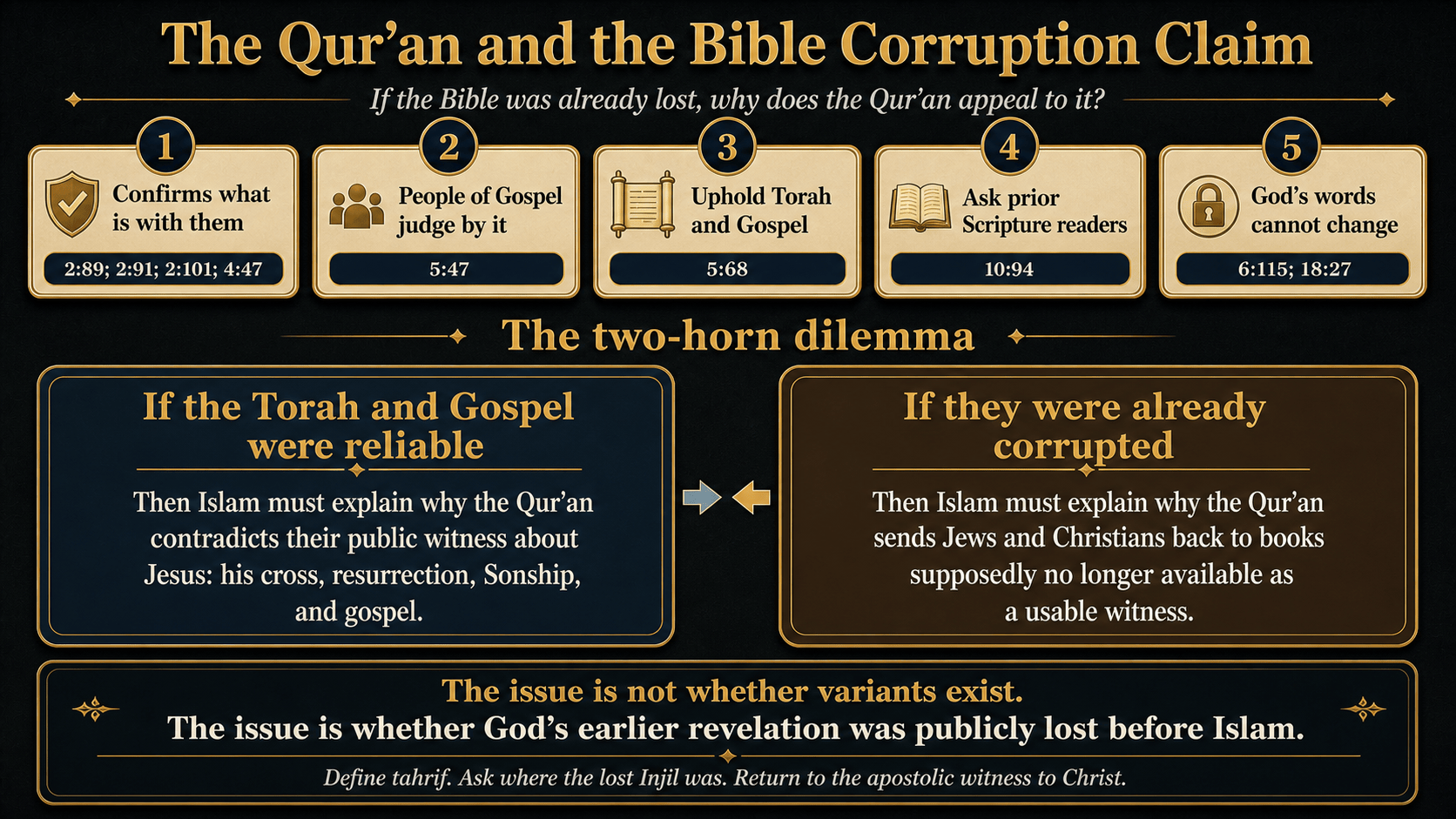
The Qur'an appeals to the Torah and Gospel
It describes them as revelation from God, guidance and light, and something the People of the Book possess and are told to uphold.
If those Scriptures were available
The appeal has real force only if Jews and Christians could consult the Torah and Gospel in their public communities.
Then Islam must explain why those Scriptures teach the cross, resurrection, divine Sonship, and final apostolic gospel.
If those Scriptures were already unusably corrupted
The corruption claim must explain why the Qur’an directs people back to books that supposedly could no longer judge the dispute.
Then Islam needs a public history of replacement that fits the manuscript, translation, and citation evidence.
The argument should not be used as a cheap slogan. It is not “the Qur’an says the Bible is perfect in every later copy,” and it is not “Muslims cannot mention any textual variant.” Christians should freely admit that textual variants exist in biblical manuscripts and that some passages are disputed. The issue is not whether copyists ever made mistakes. The issue is whether the message of the Torah and Gospel was lost, replaced, or made unusable before Islam.
It is also not an argument against every possible Muslim view in the same way. Some Muslims emphasize corruption of meaning: Jews and Christians allegedly misread or conceal the message while the text remains substantially present. Others claim textual corruption: the actual words were changed so severely that today’s Bible cannot be trusted as the Torah and Gospel the Qur’an commends. Those two claims need to be separated. Corruption of meaning does not erase the text the Qur’an tells people to consult. Corruption of text carries a much heavier historical burden.
The preservation question should not be framed as “which tradition can claim a tidier story?” The stronger historical question is: which text can be publicly tested, compared, and recovered from surviving evidence? By that standard, the Bible’s manuscript tradition is stronger than the usual Muslim objection admits.
The New Testament has many visible variants because it has many witnesses: Greek manuscripts, early translations, quotations, and geographically distributed copying streams. That abundance gives scholars material to compare. A variant in one line can be checked against others, and disputed readings can be identified rather than hidden. The evidence is messy in the way public evidence is often messy, but its very abundance is what makes recovery possible.
The Qur’an’s traditional history is different. Sahih al-Bukhari reports that after Muhammad’s death Abu Bakr commissioned Zayd ibn Thabit to collect the Qur’an from written materials and memory, and that Uthman later standardized copies for the provinces and ordered other Qur’anic materials burned. Muslim apologists argue that this preserved the Qur’an, but standardization is not the same kind of preservation as abundant independent manuscript comparison. A standardized line can produce visible uniformity while also reducing the competing evidence historians would use to test earlier diversity.
The recognized qira’at also show that Islam has its own textual-form questions. Many reading differences are pronunciation or dialectal, but some affect wording enough to be represented in translation. That does not mean there are wholly different Qur’ans. It does mean Christians should not accept the simplistic contrast that the Qur’an has no variants while the Bible has a corrupted text. The Bible’s preservation case is not weaker because its variants are visible; visibility is part of the strength of the case.
Uniformity and recoverability are not the same thing. The question is whether the surviving evidence lets the text be tested in public.
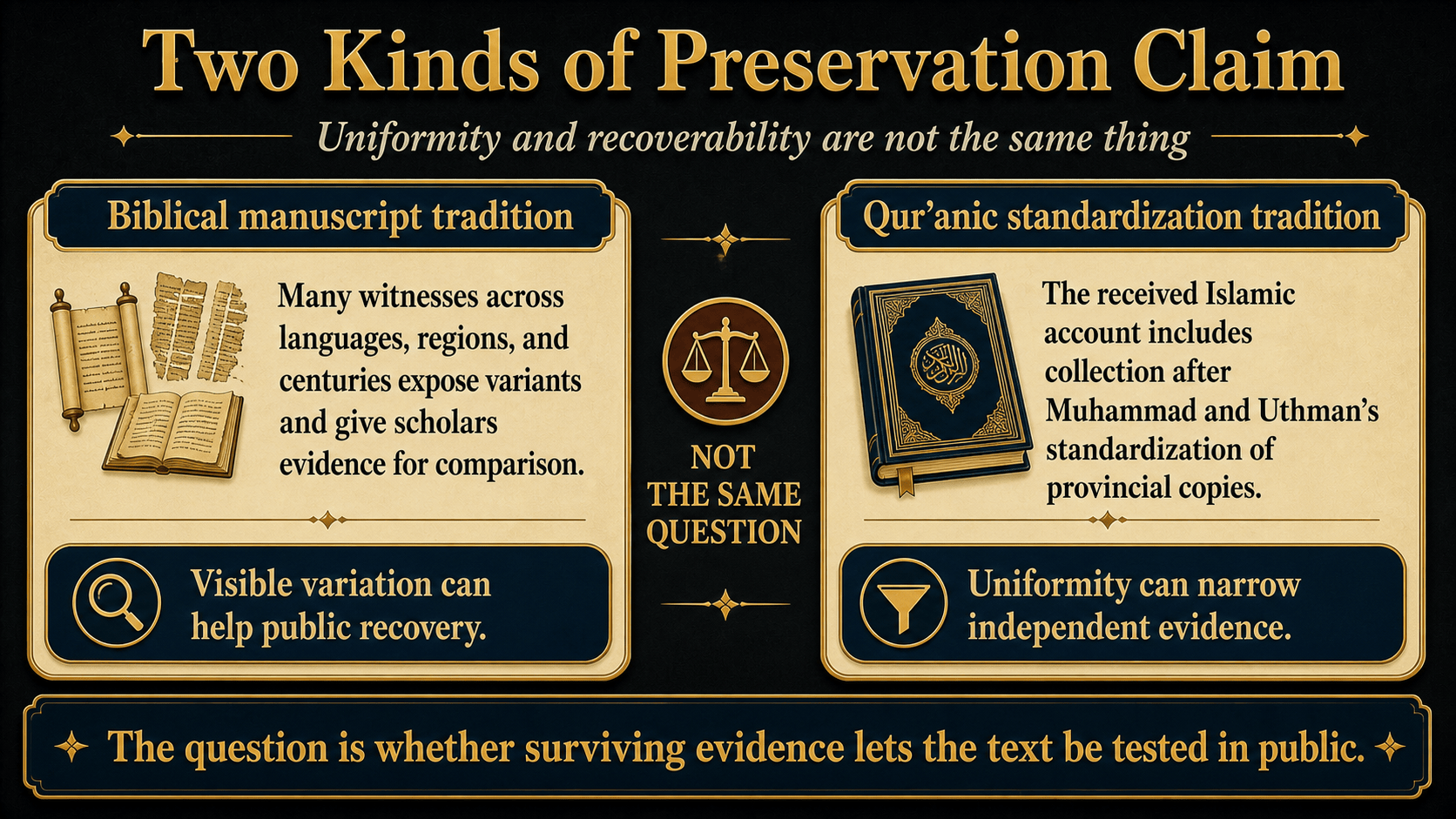
Biblical manuscript tradition
Many witnesses across languages, regions, and centuries expose variants and give scholars evidence for comparison.
Abundance creates visible variation, but it also gives the tools needed to identify and recover the earliest attainable text.
Qur'anic standardization tradition
The received Islamic account includes collection after Muhammad and Uthman’s standardization of provincial copies.
Standardization can produce uniformity, but it also narrows the surviving evidence available for independent comparison.
The Bible has the stronger public recoverability claim: its witnesses are numerous enough for variants to be tested rather than merely asserted away.
Several Qur’anic passages give the earlier Scriptures a positive role in the argument. Surah 3:3-4 says God sent down the Torah and the Gospel before the Qur’an as guidance. Surah 2:89, 2:91, 2:101, and 4:47 describe the Qur’an as confirming what is “with” the People of the Book. Surah 5:43 asks why people come to Muhammad for judgment when they have the Torah, in which is God’s judgment. Surah 5:46-47 speaks of the Gospel given to Jesus as guidance and light and tells the People of the Gospel to judge by what God revealed in it. Surah 5:66 and 5:68 tell the People of the Book to uphold the Torah, the Gospel, and what was revealed to them. Surah 10:94 can direct Muhammad, if he is in doubt, to ask those who had been reading Scripture before him.
The point is sharpened by Qur’anic statements that God’s words cannot be changed. Surah 6:34, 6:115, 10:64, and 18:27 all speak this way. A textual-corruption claim therefore carries a serious burden: it has to explain how God’s earlier revelation could be replaced or made unusable while the Qur’an speaks both of earlier Scripture as God’s revelation and of God’s words as unchangeable.
The force of the dilemma comes from the timing and audience of those statements. The Qur’an is not merely talking about heavenly originals unknown to ordinary people. It addresses communities with Scriptures in their possession. If those Scriptures were so corrupted that they no longer bore reliable witness to God’s revelation, then the Qur’an’s appeal to them loses its force. Why point Jews and Christians back to books that cannot safely adjudicate the very questions at issue?
A common Muslim reply says that the Qur’an confirms only the original Torah and original Gospel, not the present Bible. But that answer must still explain the Qur’an’s practical commands. The People of the Gospel are told to judge by what God revealed in it, and the Qur’an repeatedly speaks of confirming what is with the People of the Book. Those statements make sense if the Torah and Gospel are meaningfully available to them. They no longer make sense if the true Gospel has vanished from public history.
The dilemma does not rest on one verse. It comes from several kinds of statements working together.
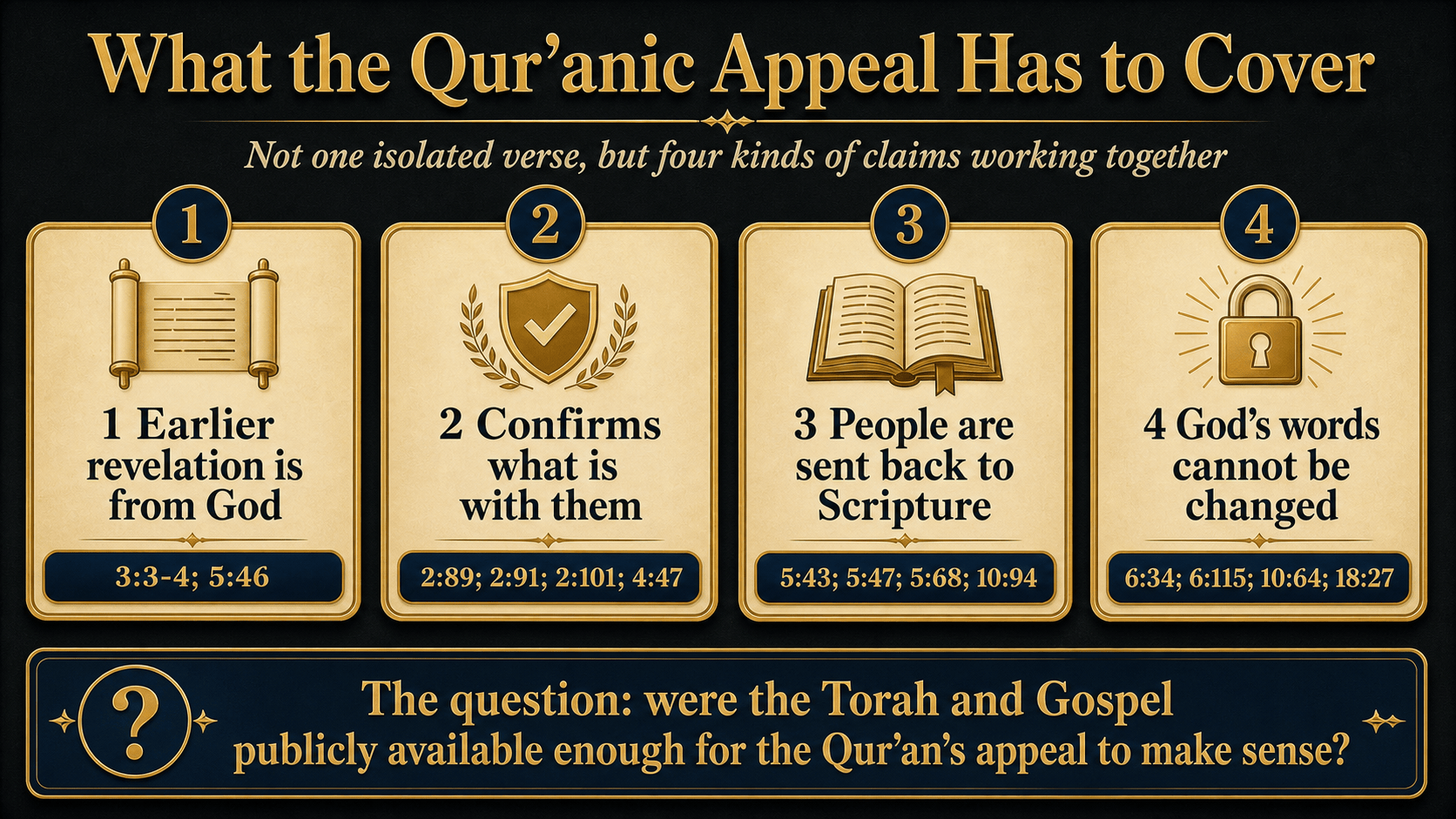
Earlier revelation is from God
The Torah and Gospel are presented as revelation given before the Qur’an, not as merely human religious memory.
The Qur'an confirms what is "with" them
The confirming language points to the Scriptures possessed by the People of the Book in the Qur’an’s own setting.
People are sent back to those Scriptures
Jews and Christians are told to judge by, uphold, or consult the revelation already associated with their communities.
God's words cannot be changed
These statements sharpen the burden on any claim that God’s earlier revelation was replaced or made unusable before Islam.
The question is not whether every manuscript copy is flawless. The question is whether the Torah and Gospel were publicly available enough for the Qur’an’s appeal to them to make sense.
If the Torah and Gospel available in the seventh century were substantially reliable, then Islam faces the first horn of the dilemma. The issue is not whether every copied word in every manuscript was identical, but whether the public witness of those Scriptures had been replaced. The Scriptures the Qur’an commends do not teach Islam’s view of Jesus. The New Testament proclaims Jesus’ crucifixion and resurrection as the heart of the gospel. Paul summarizes that message in 1 Corinthians 15:3-8 as something he received and delivered: Christ died for sins, was buried, was raised, and appeared to witnesses. The same apostolic witness identifies Jesus within the divine identity in passages such as John 1:1-3, 1 Corinthians 8:6, Philippians 2:6-11, Hebrews 1:1-3, and Revelation 1:17-18.
The disagreement is not minor. Qur’an 4:157 denies that Jesus was killed or crucified. The New Testament treats the cross as public history and saving fulfillment. Islam rejects divine sonship and the worship of Jesus. The New Testament presents the Son as the eternal Word through whom all things were made and as the risen Lord whom believers worship. If the Qur’an confirms the Scriptures Christians possessed, the Qur’an must explain why it contradicts them on the very identity and saving work of Christ.
Press this from the evidence. The point is not that Muslims must accept every Christian interpretation without argument. The point is that the biblical evidence is not ambiguous on the cross, resurrection, and divine status of Christ in the way Islam would need it to be. The early Christian message that Islam rejects is not a medieval addition sitting at the edge of the tradition. It is woven through the earliest apostolic witness.
If the Torah and Gospel were already textually corrupted before Muhammad, then Islam faces the second horn. The claim has to explain why the Qur’an speaks the way it does about books supposedly no longer fit to judge by. It also has to explain when and how the replacement happened.
That historical burden is large. By the time of Muhammad, Christianity had spread across regions, languages, and churches that did not answer to one earthly center. The New Testament existed in Greek manuscripts, ancient translations, lectionaries, quotations, and theological controversies. Earlier manuscripts and patristic citations already testify to the same central claims Islam later denies: the crucifixion, resurrection, divine sonship, and apostolic gospel. A universal pre-Islamic replacement of the Gospel would need to cross geography, language, and hostile church divisions while leaving no surviving trace of the allegedly original Islamic-friendly Gospel.
If the corruption is placed after Muhammad, the problem becomes sharper. Manuscripts and quotations before and after Islam do not show the Bible changing from Islamic theology into Christian theology. The Christian claims Islam disputes are already present before the Qur’an and remain present after it. So the corruption charge either comes too early to fit the Qur’an’s appeal to Scripture, or too late to explain the manuscript evidence.
The timing matters because each possible location for the corruption claim creates a different evidence problem.
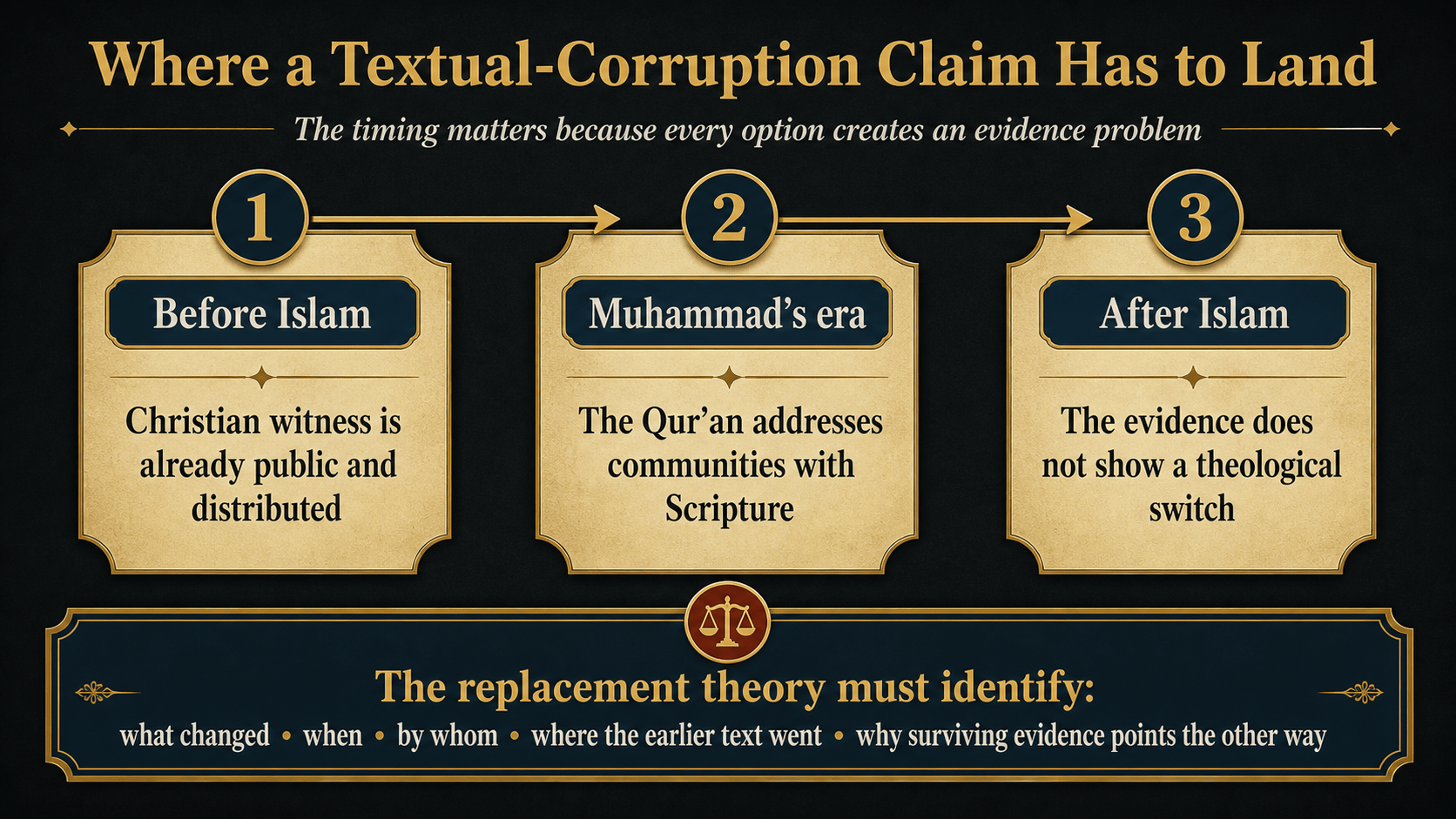
Before Islam
Christian witness is already public and distributed
Manuscripts, translations, lectionaries, quotations, and church controversies already carry the same central claims Islam later denies.
Muhammad's era
The Qur'an addresses communities with Scripture
The appeal to what is “with” the People of the Book makes best sense if their Scriptures can still function as public witnesses.
After Islam
The evidence does not show a theological switch
Manuscripts before and after Islam do not change from an Islamic-friendly gospel into the Christian gospel of the cross, resurrection, and divine Son.
A replacement theory has to identify what changed, when it changed, who changed it, where the earlier text went, and why the surviving evidence points the other way.
The Arabic term often used here is tahrif, corruption or alteration. But in conversation it can slide between different meanings. A Christian answer should ask which claim is being made.
If the claim is tahrif al-ma’na, corruption of meaning, then the Muslim is saying Jews and Christians misunderstand, twist, or conceal the meaning of Scripture. That claim does not prove the biblical text is gone. In fact, it often assumes the text remains available enough to be misread. The Christian can then ask for an exegetical argument from the actual text: show where the Torah and Gospel teach Islam’s view of Jesus when read in context.
If the claim is tahrif al-nass, corruption of the text, then the Muslim is making a historical claim about changed words. That requires more than pointing to textual variants or theological disagreement. Variants are real, but they are not the same thing as the disappearance of the message. The New Testament manuscript tradition is public enough for scholars to identify variants, compare witnesses, and see that the core gospel does not rest on late disputed passages. A textual-corruption claim has to identify what was changed, when, by whom, where the earlier text went, and why the evidence points in the opposite direction.
Defining tahrif keeps the discussion from sliding between an interpretive claim and a historical claim.
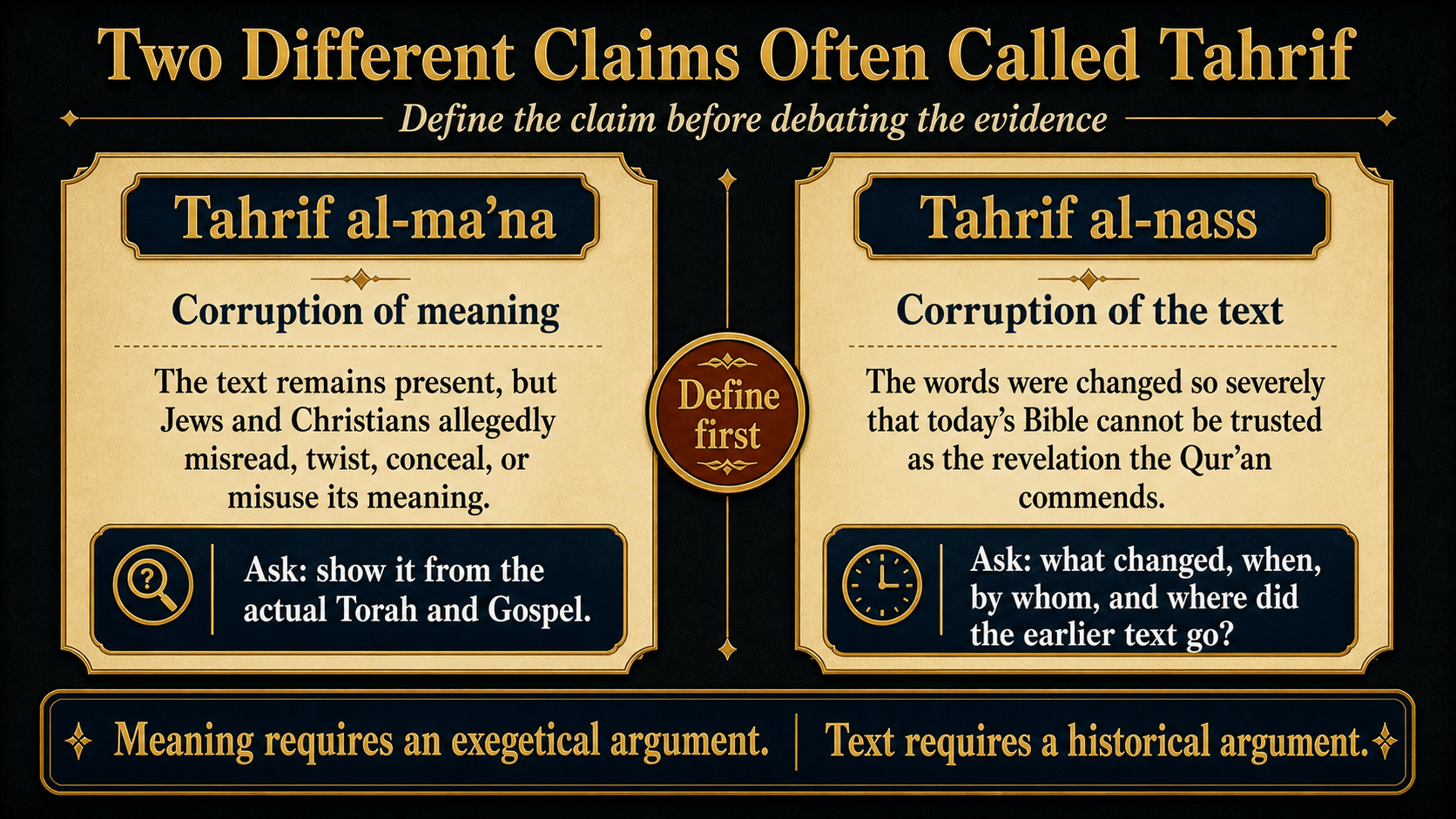
Tahrif al-ma'na
The text remains substantially present, but Jews and Christians misread, twist, conceal, or misuse its meaning.
Show from the actual Torah and Gospel where they teach Islam’s view of Jesus when read in context.
Tahrif al-nass
The words of the text were changed so severely that today’s Bible cannot be trusted as the revelation the Qur’an commends.
Identify the changed words, the time and agents of the change, the earlier text, and the evidence for that reconstruction.
Corruption of meaning requires an exegetical argument. Corruption of text requires a historical argument.
One reply says the Qur’an supersedes the Bible. Supersession and corruption are not the same claim. Even if a Muslim argues that the Qur’an is the final revelation, the question remains whether the Qur’an can affirm earlier revelation while denying what that earlier revelation plainly teaches about Jesus.
Another reply says the Qur’an gives only a general confirmation of earlier revelation, not total confirmation of every biblical text. That is true as far as it goes, but it does not remove the problem. The dilemma does not require the Qur’an to affirm every copied word in every manuscript. It asks what the Qur’an is confirming when it speaks of what is with the People of the Book and tells the People of the Gospel to judge by what God revealed in it. If the central public witness of those Scriptures was false on Jesus’ cross, resurrection, Sonship, and gospel, then “general confirmation” has to define what meaningful authority was actually being confirmed.
A related reply says the Qur’an refers only to the true Torah and true Gospel, not the books Christians now have. That answer must identify the books being referenced. What written Gospel did Christians possess in Muhammad’s day? Where is it? Who used it? Why does the Qur’an speak of what is with the People of the Book if the true revelation was no longer publicly available? Why do the Christian communities addressed by the Qur’an leave no trace of such a text? A lost book cannot solve the dilemma unless there is evidence that it existed where and when the argument needs it.
Another reply narrows “God’s words cannot be changed” to God’s promises, commands, or decrees. Some passages may carry that sense, so Christians should not make the whole argument rest on one phrase. But the narrowing is still too selective if it is used to dismiss the dilemma. Surah 18:27 speaks of reciting what has been revealed from the Book of the Lord before saying none can change his words, and the broader Qur’anic pattern still remains: God revealed the Torah and Gospel, speaks of them as guidance and light, and sends people to judge by them.
Another reply says Surah 10:94 is about Muslim converts who had read the previous Scriptures, not about Jews and Christians as trustworthy communities. That changes the label without removing the logic of the appeal. However the verse is applied, it appeals to people who had been reading Scripture before the Qur’an as a credible witness. If their Scriptures were already unusably corrupted, the appeal loses its force.
A further reply points to biblical variants. This is an important topic, but it does not by itself establish Islamic tahrif. Christians can acknowledge variants, disputed passages, and scribal mistakes while still maintaining that the apostolic message is recoverable and has not been replaced. The dilemma is not answered by showing that copies differ in places. It is answered only by showing that the biblical witness to Jesus was lost or transformed in the way Islam requires.
A stronger version of that reply says the Qur’an is perfectly preserved while the Bible is not. That claim needs a fair historical standard. The Qur’an’s own received history includes post-prophetic collection, Uthmanic standardization, and recognized qira’at. Those facts do not automatically disprove Islam, but they do prevent the Muslim critic from treating collection history and textual variation as fatal only when they appear in Christianity. The Bible’s advantage is not that it has no variants. Its advantage is that the evidence is abundant enough to expose, test, and weigh them.
Finally, some say Christians interpret the Bible through later doctrine. Test that charge passage by passage. The cross, resurrection, and divine status of Christ do not depend on one late council or one isolated proof text. They are built into the New Testament’s narrative, worship, letters, confessions, and Scripture readings. The Christian claim is not that later theology invented those truths, but that later theology defended what the apostolic writings already taught.
The Islamic dilemma is most useful when it becomes a set of clear questions rather than a trap. Ask what the Muslim means by “the Bible is corrupted.” Ask whether the Qur’an’s positive statements about the Torah and Gospel refer to Scriptures available to Jews and Christians in Muhammad’s day. Ask when the alleged textual corruption happened. Ask what evidence identifies the original Gospel if Matthew, Mark, Luke, and John are rejected. Ask whether the Qur’an’s denial of the crucifixion fits the earliest public evidence.
Keep the tone calm. Many Muslims have been taught from childhood that the Bible is corrupted, and the claim often functions as a shield against reading the New Testament on its own terms. The aim is not to score a point but to remove an assumption. Once the corruption claim is seen to need evidence, the conversation can return to Jesus: was he crucified, did he rise, and who is he?
That is where the argument belongs. The dilemma clears ground for the gospel; it is not a replacement for the gospel. Christians should move from the internal tension in Islam to the positive apostolic witness: Christ died for our sins, was buried, was raised, and appeared to witnesses. If that message is true, then the final word about Jesus is not a later denial of the cross but God’s public vindication of his Son.
Bottom line
The Islamic dilemma asks Islam to choose between two difficult claims. If the Torah and Gospel available to Jews and Christians were reliable enough for the Qur’an to affirm and appeal to, then the Qur’an conflicts with the Scriptures it commends on the cross, resurrection, and identity of Jesus. If those Scriptures had already been textually corrupted, then the Qur’an’s appeal to them stands unexplained and the corruption claim needs a history the manuscript evidence does not supply. The preservation comparison sharpens the point: the Bible’s abundant manuscript evidence exposes variants and enables public recovery, while the Qur’an’s received history includes collection, standardization, and recognized readings. Press the issue with definitions and sources, because its purpose is to bring the conversation back to the apostolic witness to Christ.
Continue
Start with Islam's own claims about Allah, the Qur'an, Muhammad, and the denial of shirk, then follow the related objections and arguments about Jesus, Scripture, and the gospel.
Open IslamOfficial source
Quran.com presentation of the Qur’an with English translation support, used for mainstream Islamic references.
The Qur’an, Quran.com, accessed June 16, 2026.
Open sourcePrimary source
A major Sunni hadith collection presented by Sunnah.com.
Sahih al-Bukhari, Sunnah.com, accessed June 16, 2026.
Open sourcePrimary source
Medieval Muslim polemical source associated with strong textual-corruption arguments.
Ibn Hazm, al-Fisal fi al-milal wa-al-ahwa wa-al-nihal.
Representative source
Muslim apologetic overview of the traditional account of the Qur’an’s collection and Uthmanic standardization.
Ammar Khatib and Nazir Khan, “The Uthmanic Codex: Understanding how the Qur’an was Preserved,” Yaqeen Institute, June 22, 2022, updated July 22, 2024.
Open sourceRepresentative source
English translation project that marks meaning-affecting variations among the ten canonical qira’at.
Fadel Soliman, Bridges’ Translation of the Ten Qira’at of the Noble Qur’an, Bridges Foundation, 2020.
Open sourceSecondary context
Academic study of the transmission, canonization, and classification of Qur’anic variant readings.
Shady Hekmat Nasser, The Transmission of the Variant Readings of the Qur’an: The Problem of Tawatur and the Emergence of Shawadhdh, Brill, 2012.
Open sourceSecondary context
Christian apologetics treatment of Islam and Christianity by a former Muslim.
Nabeel Qureshi, No God but One: Allah or Jesus?, Zondervan, 2016.
Reference
Reference work on New Testament textual transmission.
Bruce M. Metzger and Bart D. Ehrman, The Text of the New Testament: Its Transmission, Corruption, and Restoration, 4th ed., Oxford University Press, 2005.
Reference
Explanation of the Gregory-Aland numbering system and the cataloging of Greek New Testament manuscripts.
Center for the Study of New Testament Manuscripts, “Manuscripts 101: GA Numbers,” October 24, 2022.
Open sourceReference
Institute for New Testament Textual Research discussion of manuscript-counting complexity in the NTVMR and Kurzgefasste Liste.
Katie Leggett and Greg Paulson, “How Many Greek New Testament Manuscripts Are There Really? The Latest Numbers,” Institute for New Testament Textual Research, September 29, 2023.
Open sourceReference
BibleRef provides reference material for Scripture passages.
BibleRef, accessed June 16, 2026.
Open source