Official source
The Qur'an
Quran.com presentation of the Qur’an with English translation support, used for mainstream Islamic references.
The Qur’an, Quran.com, accessed June 16, 2026.
Open sourceObjection
The Bible has been corrupted, so Christians no longer possess the Injil or reliable revelation given to Jesus.
Textual variants are real, but the New Testament message has not disappeared; Christians can distinguish variants from total loss and can ask where, when, and by whom the alleged lost Injil was replaced.
Visual summary
Concise visual summaries for teaching, discussion, and sharing.
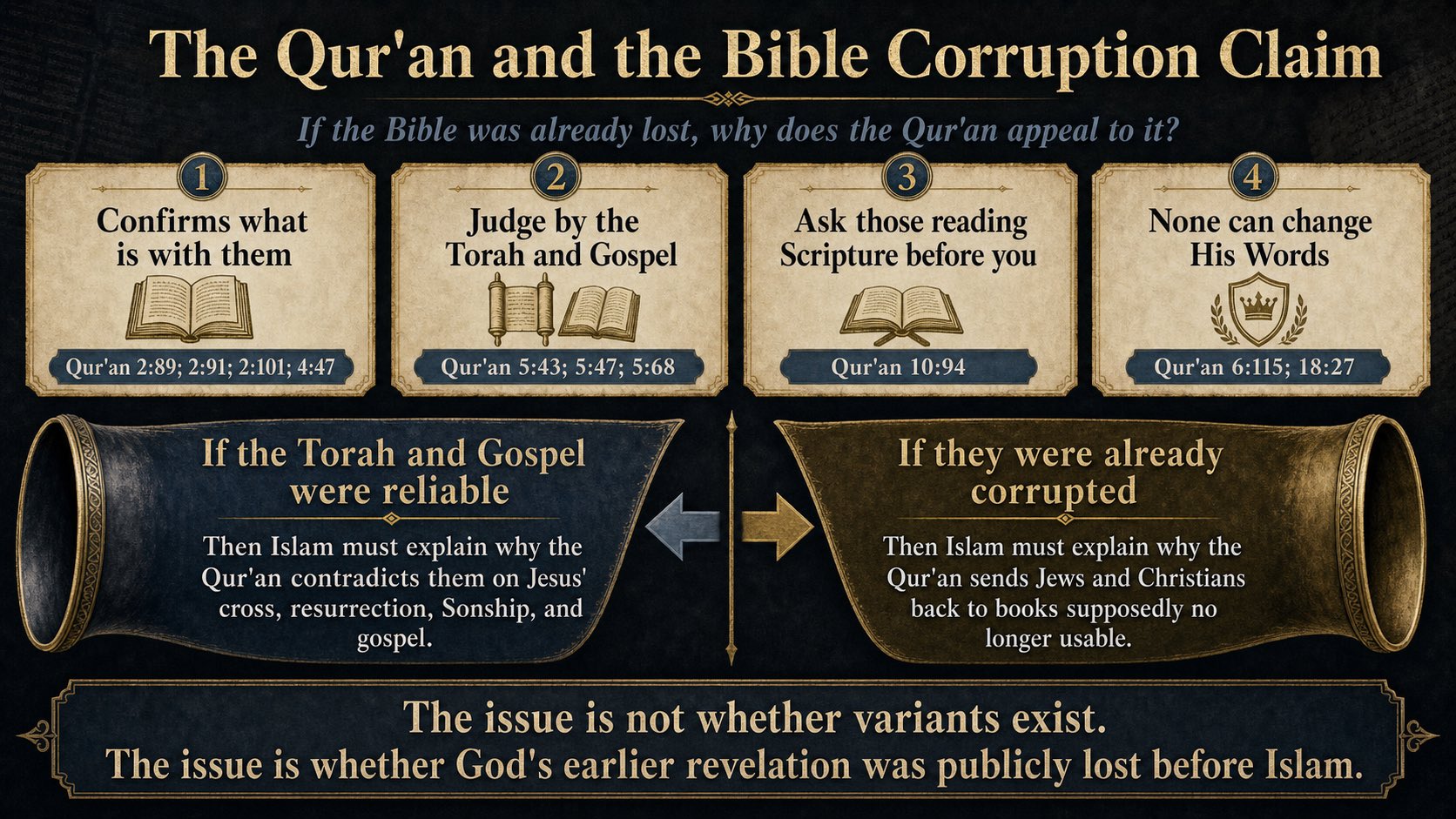
A concise dilemma for the claim that the Torah and Gospel were already unusable when the Qur'an appealed to them.
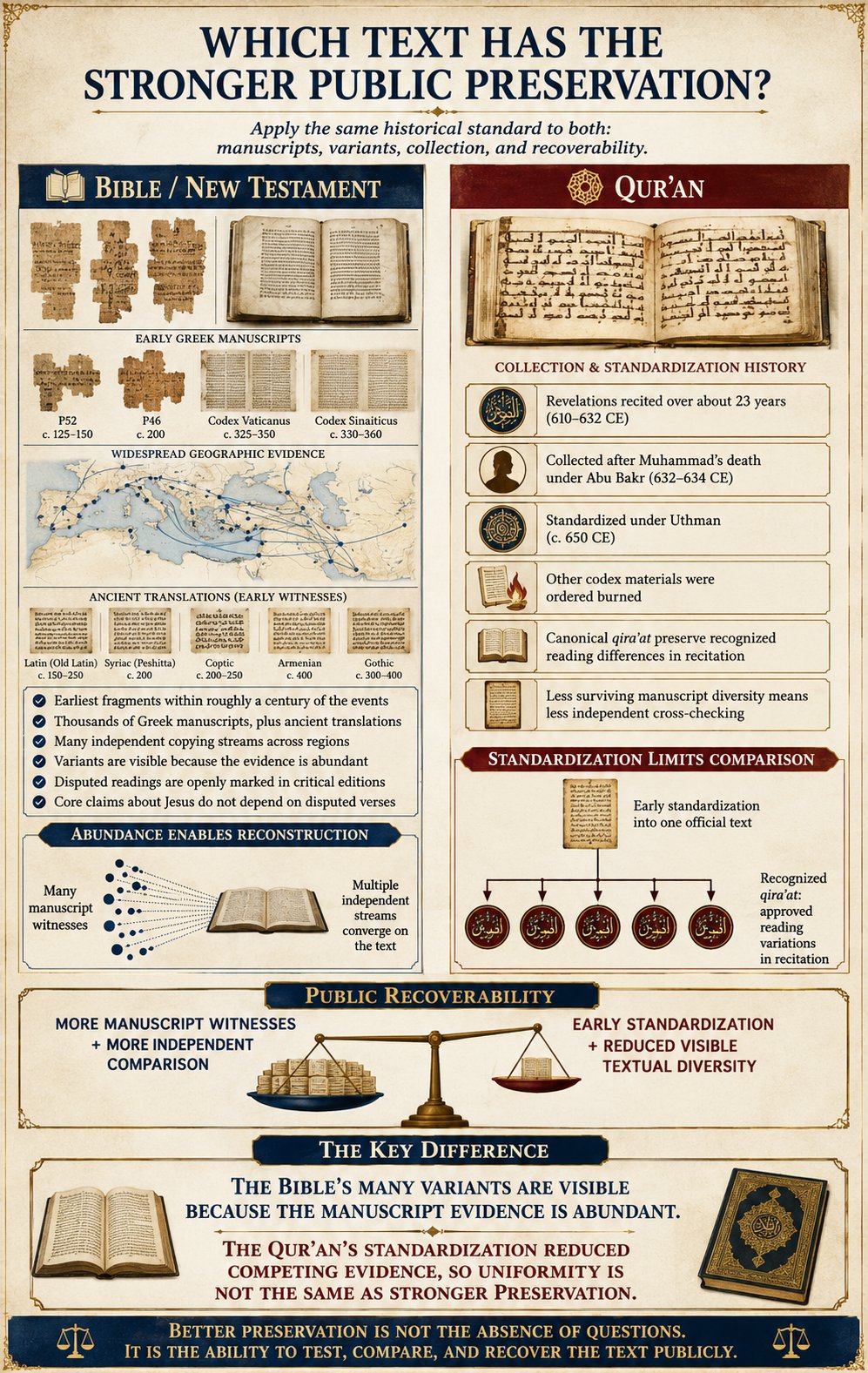
A side-by-side comparison of public recoverability, manuscript abundance, variants, collection history, and standardization claims.
Start by granting what is true, because it costs nothing and buys credibility. There are hundreds of thousands of variants across the manuscripts. A handful of well-known passages, including the Comma Johanneum (1 John 5:7), the longer ending of Mark, and the woman caught in adultery (John 7:53–8:11), are very probably not original. We do not possess the autographs of any New Testament book.
Christian scholarship says all of this out loud. It is printed in the footnotes of ordinary study Bibles. The question is what follows. “The wording of some verses is debated” and “the message Jesus gave has been lost and replaced” are completely different claims, and only the first is supported by the evidence.
Classical Muslim thought never settled on one version of the charge:
These need different evidence and lead to different places. Ibn Hazm pressed the harder, textual version; many others (and much of the Qur’an’s own language) fit the softer one. This matters because the Qur’an addresses Jews and Christians who possess their scriptures and tells them to judge by what is in them (Surah 5:43, 47; 10:94). A book that tells the People of the Gospel to consult the Gospel in front of them undercuts the claim that the Gospel had already been destroyed.
The strongest internal pressure is not merely that the Qur’an says God once gave the Torah and the Gospel. It speaks to Jews and Christians in Muhammad’s own setting as people who still have Scriptures with public authority. Surah 2:89, 2:91, 2:101, and 4:47 describe the Qur’an as confirming what is “with” the People of the Book. Surah 5:43 says Jews have the Torah with God’s judgment in it. Surah 5:47 tells the People of the Gospel to judge by what God revealed in it. Surah 5:68 says the People of the Book have nothing to stand on unless they uphold the Torah, the Gospel, and what was revealed to them.
That does not require Christians to claim every biblical manuscript is word-for-word identical. The claim is narrower and stronger: the Torah and Gospel texts available before, during, and after Muhammad are substantially the same public texts we can inspect today, and they already teach the crucifixion, resurrection, divine Sonship, and apostolic gospel Islam rejects. If those Scriptures were trustworthy enough for the Qur’an to confirm and appeal to, Islam must explain why the Qur’an contradicts them. If they were already textually corrupted beyond use, Islam must explain why the Qur’an still sends Jews and Christians back to them.
Engage Ehrman fairly, because his data is real and his conclusion is overstated. The vast majority of variants are spelling slips, word-order differences, and obvious nonsense readings that change nothing a translation would show. The reason there are so many variants is that there are so many manuscripts, and that abundance is exactly what lets scholars triangulate the original and expose the few late additions. A corruption that hides itself leaves no trail. This one is catalogued in the apparatus of every critical edition.
Even Ehrman concedes the decisive point: no essential Christian doctrine is left in jeopardy by the textual variants. Jesus as God, the resurrection, and the gospel do not stand on the disputed verses. Metzger’s lifetime of work pointed the same way; the New Testament text is recoverable to a very high degree of confidence. A discipline that is public, self-correcting, and verifiable is the opposite of a secret tampering.
When the objection comes from a Muslim critic, do not let the standard shift mid-conversation. The Islamic tradition itself reports a collection and standardization history. In Sahih al-Bukhari, Abu Bakr commissions Zayd ibn Thabit to collect the Qur’an after deaths among the reciters at Yamamah, and Zayd gathers it from written materials and memory. Later, Uthman commissions a standard codex for the provinces and orders other Qur’anic materials burned. Muslim apologists can argue that this preserved the Qur’an, but they cannot then say that human collection, scribal transmission, or a post-prophetic standardization process automatically disqualifies the Bible.
Nor is it accurate to say that Islam has no textual-form question at all. Mainstream Islam recognizes canonical qira’at, or readings. Many differences are recitational, but some are meaningful enough to appear in translation; Bridges’ Translation of the Ten Qira’at explicitly marks the subset of qira’at variation that affects meaning in English. That does not prove Islam false by itself. It does show that the simplistic contrast “the Qur’an has one unchanged text, while the Bible has versions” is not careful enough to bear the argument.
The fair comparison is this: Christianity has a manuscript tradition with many visible variants and enough surviving evidence to evaluate them. Islam has an early standardizing tradition that reduced visible manuscript diversity and later canonized multiple readings. Both traditions need to answer historical questions. The New Testament should not be dismissed by a standard that would create harder questions for the Qur’an.
Press the positive question back. If the real Injil was a single book handed to Jesus and then swapped out for the four canonical Gospels, that event has to have happened somewhere, at some time, by someone, and it should have left a seam. It did not. Before Islam, Christianity was already spread from Spain to India, in Greek, Latin, Syriac, and Coptic, with thousands of manuscripts and a flood of quotations in the church fathers, all converging on the same fourfold Gospel. No competing “original Injil” survives, no record of its suppression exists, and no geography escaped the alleged edit in unison.
Meanwhile the core message is traceable to the very beginning: the creed Paul cites in 1 Corinthians 15:3–8, that Christ died for our sins, was buried, and was raised, is widely dated by scholars to within a few years of the crucifixion. The honest verdict is not that the message vanished, but that it was reliably transmitted and is the gospel the apostles finally delivered.
The most useful question is often not “Can Christians answer every charge at once?” but “What exactly does the Muslim claim the Qur’an is identifying?” Surah 7:157 speaks of Muhammad being found written with the People of the Book in the Torah and the Injil. Surah 5:46-47 says the Gospel given to Jesus contained guidance and light and tells the People of the Gospel to judge by what God revealed in it. Surah 10:94 can even direct Muhammad, if in doubt, to those who had read Scripture before him. Surah 6:115 and 18:27 also say that God’s words cannot be changed, which raises the burden for any claim that God’s earlier revelation became unavailable as a usable witness.
Those texts create a burden for the lost-Injil claim. If the Qur’an is pointing its hearers to a Gospel that Christians possessed in Muhammad’s day, what was that written Gospel? Who wrote it? When was it written? Where did it circulate? Why is there no trace of it among the Christians the Qur’an addresses? If the answer is “we do not know,” then the claim that Matthew, Mark, Luke, and John cannot be that Gospel is not an argument from evidence. It is an escape from the evidence.
Full rebuttal
Christian answers should neither overstate what textual evidence can prove nor concede the false claim that ordinary variants erase the Bible’s message. The transmission is well documented, the variants are largely trivial and always identifiable, the apostolic testimony was public, and no central doctrine hangs on a disputed reading.
Reliability does not mean we possess the autographs, or that no scribe ever slipped. It means two things: the message the biblical writers delivered can be recovered with confidence from the evidence we have, and that message rests on testimony open to public examination rather than on a private vision no one else could check.
Granting the first point honestly actually strengthens the case. We are not claiming a miracle of flawless copying; we are claiming that the manuscript tradition is rich enough to correct itself and recover what was written.
Critics rightly point out that the manuscripts contain many variant readings; Bart Ehrman’s popular work makes much of the count. But the same scholarship that catalogs the variants also explains why they do not bury the message:
Even on Ehrman’s own account, the central teachings of the faith are not left hanging on a disputed text. Metzger and Ehrman’s standard handbook treats the goal of the discipline as the recovery of the earliest text; a recovery the evidence makes possible, not a loss it makes permanent.
The Bible’s most important claims are tied to public events and named witnesses. Paul, writing within a few years of the events, hands on a creed he himself “received”: that Christ died, was buried, and was raised, and appeared to named people and to crowds, “most of whom are still living”; an open invitation to check (1 Corinthians 15:3-8). Hebrews opens by appealing to God’s speech “in these last days” through the Son, a matter of public proclamation.
Richard Bauckham argues that the Gospels read as eyewitness testimony rather than free-floating folklore: named figures, identifiable tradents, and the controlled memory of communities close to the events. Whatever one finally concludes, this is the opposite of a secret revelation that cannot be examined.
Jude appeals to “the faith entrusted once for all to the saints”; a settled, shared deposit, not a private possession revised at will. The recognition of the canon was likewise a public, communal process: the churches received the writings that carried apostolic testimony, rather than a single authority inventing scripture behind closed doors.
The meme that asks “which Bible is approved by God?” points to a real but often misused question. Protestants, Catholics, Orthodox, and Ethiopian Orthodox Christians count Old Testament or deuterocanonical books differently. That should be answered honestly. But those differences are not different New Testaments about Jesus. The major Christian traditions receive the same twenty-seven New Testament books, and the disputed Old Testament edges do not create or erase the apostolic witness to the crucifixion, resurrection, and identity of Christ.
This matters when answering claims that the Bible was secretly stripped of “plain and precious truths,” as discussed in the Bible lost plain and precious truths. A public, widely copied, widely cited text is the hardest kind of document to secretly gut.
Muslim critics sometimes press the Bible with a standard they do not apply to the Qur’an: later manuscripts, collection history, named or unnamed human writers, copyist variants, and canon recognition are treated as fatal for Christianity but harmless for Islam. That is not a neutral standard.
The traditional Sunni account does not present the Qur’an as a leather-bound book written by Muhammad and handed unchanged to later generations. Muhammad recited revelations over about twenty-three years; companions memorized and wrote them; after Muhammad’s death Abu Bakr commissioned Zayd ibn Thabit to collect the Qur’an because reciters had died at Yamamah; and Uthman later standardized the text for the provinces and ordered other Qur’anic materials burned. Muslim writers may argue that this process preserved the Qur’an. But then collection by witnesses, post-event writing, human scribal work, and standardization cannot be used automatically to dismiss the Bible.
The qira’at make the point sharper. Mainstream Islam recognizes multiple canonical readings of the Qur’an. Many differences are pronunciation or dialectal, but some affect wording enough to be represented in translation; Bridges’ Translation of the Ten Qira’at says it footnotes the portion of qira’at variation that affects meaning in English. That does not by itself disprove Islam, just as New Testament variants do not by themselves disprove Christianity. It does mean the slogan “our text has no versions while yours does” is too simple. The better question for both books is whether the public evidence preserves the message it claims to preserve.
The strongest objection, developed in the Bible is corrupted, is the “telephone game”: across centuries of hand-copying, errors must have compounded until we can no longer know what was first written.
But transmission is not a single chain whispered ear to ear. It is many independent lines of copying, beginning early and spreading quickly across regions and languages. Because the lines are independent, a corruption in one branch is exposed by the others; there is no single point through which an error could pass undetected to everyone. The absence of the original autographs is normal for every ancient text and does not prevent reconstruction; for the New Testament the evidence is earlier and far more abundant than for any other work of antiquity. The honest conclusion is not “we cannot know,” but “we can identify the disputed points, and they are few and doctrinally minor.”
Bottom line
Biblical reliability is a modest, defensible claim: the message is recoverable and the testimony is public. The manuscript tradition is rich enough to expose its own variants, and the variants that matter are few and touch no core doctrine. Far from a private revelation passed down a fragile chain, the Bible’s central claims were proclaimed in public, tied to named witnesses, and preserved across many independent lines of copying.
The New Testament should be weighed as a body of first-century testimony close to its events, not dismissed by assuming corruption or by treating ordinary textual variation as total loss. Its core message is early and public, its sources read as eyewitness memory, and its text is the best attested of any ancient writing.
The heart of the New Testament message is not a second-century invention. In 1 Corinthians 15:3-8 Paul passes on a creed he had himself “received”: Christ died for our sins, was buried, was raised, and appeared. Scholars widely date that language to within just a few years of the crucifixion. In Acts 2 Peter preaches in Jerusalem about events the crowd already knew, appealing to “Jesus of Nazareth… as you yourselves know,” in the very city where it happened.
This is testimony that invited correction. A movement built on public claims about recent, local events, proclaimed to people who could have refuted it, is a poor candidate for quiet fabrication.
Luke opens his Gospel by saying he drew on what had been handed down by the original eyewitnesses and servants of the word, writing an orderly account so his reader could know the certainty of what he had been taught. Richard Bauckham argues that the Gospels carry the marks of eyewitness testimony rather than anonymous legend: named individuals who functioned as known sources, traditions tied to specific people, and the controlled memory of communities still close to the events.
The gap between Jesus and the written Gospels is short by the standards of ancient history, and the chain runs through identifiable witnesses, not centuries of untraceable retelling.
No work of antiquity is preserved in as many early manuscripts as the New Testament. Metzger and Ehrman’s standard handbook frames the discipline’s task as recovering the earliest text from this abundance, and the abundance is exactly what makes recovery possible:
Variation is the signature of a heavily copied text, not proof that the message was lost. This is treated more fully in the reliability of the Bible and the Bible is corrupted.
Jude appeals to “the faith entrusted once for all to the saints.” The apostolic message was a public deposit, guarded and widely circulated, not a secret later edited by winners. The alternative “gospels” sometimes cited as suppressed originals, the gnostic texts, are demonstrably later than the canonical four and reflect second-century movements, not an earlier, purer record that was hushed up.
So the choice is not between a tidy church story and a hidden true history. It is between early, public, multiply attested testimony and later documents that themselves presuppose the earlier ones.
The strongest objection runs: the Gospels are anonymous, written decades after the events by committed believers, so they are partisan theology rather than history, and the more radical form, treated in Jesus never existed, doubts the events altogether.
Several replies hold together:
Bottom line
The New Testament is early, public, and the best-attested text of the ancient world. Its core proclamation can be dated to within a few years of the events, its narratives carry the marks of eyewitness testimony, and its text is recoverable precisely because it was copied so widely. Honest critics grant that Jesus lived and was crucified. The real debate is about who he was, and on that the documents speak with one early, examinable voice.
Christian testing of later claims is not hostility to revelation. It is obedience to the apostolic warnings about contrary gospels and to the faith entrusted once for all to the saints as a deposit to be guarded, climaxing in God’s final word in the Son, with grace as its non-negotiable core.
Concede the legitimate worry first: a faith that never lets anything new be said can calcify into mere traditionalism. But that is not what is at stake here. The New Testament does not describe the gospel as an evolving conversation. It describes it as a deposit: something received, entrusted, and to be guarded intact.
Jude makes the point in a single phrase: “the faith which was once delivered unto the saints.” The word translated “once” means once-for-all, not once-upon-a-time. Paul tells Timothy to “hold fast the form of sound words” and to “keep” the “good thing which was committed unto thee.” The posture toward the apostolic gospel is custodial: you do not improve a deposit, you protect it.
This is why the question to ask of any later movement is not whether it is sincere, growing, or spiritually moving, but whether its message is the same gospel the apostles delivered: the gospel Paul says he received and passed on, “how that Christ died for our sins according to the scriptures… and that he rose again the third day.”
Paul anticipates the very move later claims rely on. He does not say “reject any rival preacher because he is less credentialed than I am.” He says the opposite: “though we, or an angel from heaven, preach any other gospel unto you than that which we have preached unto you, let him be accursed.” He stakes the test on content, not credentials, and he disqualifies even himself and even an angel if the message changes.
That is decisive for how to weigh an impressive origin story. A recovered set of plates, a recited revelation of surpassing beauty, an angelic messenger: none of these is the criterion. The criterion is whether the resulting gospel agrees with the one already given. A book offered as another testament alongside the Bible, or a message claiming to restore truths the church supposedly lost, must be measured by that standard, however moving its arrival. The argument over the testing framework itself sets this out in full. Here the point is narrower and sharper: even heaven’s own angel would not be exempt.
Not every disagreement changes the gospel. People can differ on church order, prophecy, and a hundred secondary matters while preaching the same good news. So it matters to name what cannot move: the basis of salvation.
Paul draws the line at grace. “By grace are ye saved through faith; and that not of yourselves: it is the gift of God: not of works, lest any man should boast.” He puts the stakes starkly: “if righteousness come by the law, then Christ is dead in vain.” A message that leaves the words grace, Christ, and faith in place but relocates final salvation onto human merit, ritual attainment, or a ladder of exaltation earned by works has not added detail to the gospel. It has swapped out its foundation. That is precisely the kind of change Paul calls “another gospel.”
The strongest objection is not that the apostles were unimpressive but that finality is arbitrary: God spoke progressively through Moses and then the prophets, so why assume the installments end with the apostles? Isn’t “no more revelation” just a door slammed to protect the status quo, the same instinct that, the claim goes, drove the church to lose plain and precious truths?
The answer is that the finality is not arbitrary; it is built into how the story was always told.
So rejecting a contrary gospel is not fear of God speaking again. It is taking seriously that God has spoken his final word in the Son, and that the faith built on that word was delivered to the saints once for all.
Bottom line
The apostolic gospel is a deposit delivered once for all, not a draft awaiting revision. Paul ties the test to content, not credentials. Even an angel preaching another gospel is accursed. And he draws the immovable line at grace: relocate salvation onto human merit and you have changed the gospel, not enriched it. Revelation reaches its goal in the Son, after whom the task is to guard the deposit, not await the next installment. Measure every later claim by that gospel, and reject what contradicts it however it arrived.
Ehrman says there are more variants than there are words in the New Testament. Doesn’t that sink it?
The figure is true and routinely misused. It counts every difference across roughly 5,800 Greek manuscripts plus the versions, so more witnesses inevitably means more variants, and also more power to reconstruct the original by comparison. What matters is not the raw count but how many variants are both meaningful and genuinely in doubt, and that number is very small. Ehrman himself grants that none of them puts a central Christian teaching at risk.
The Comma Johanneum and the ending of Mark prove the text was tampered with.
They prove the system works. Those are precisely the passages textual criticism flagged and bracketed, not corruptions hiding in the dark but corrections made in the open. And none of them carries a doctrine on its own: the Trinity rests on the whole shape of the New Testament, not on 1 John 5:7. Identifying a late addition and labeling it is evidence of a reliable process, not a broken one.
But you admit you don’t have the originals.
No one has the autograph of any ancient work, not Tacitus, not Homer, and not the Qur’an, whose own transmission involved Uthman standardizing the text and burning variant codices. The real question is whether the original wording is recoverable from the surviving witnesses, and by that measure the New Testament is the best-attested document of antiquity by a wide margin, both in the number of manuscripts and in how close they stand to the events.
Aren’t your earliest manuscripts hundreds of years after Jesus, by unknown authors in a language Jesus did not speak?
That objection compresses several half-truths into one slogan. Complete New Testament codices are later, but fragments and quotations begin earlier, and the books themselves are first-century writings, not fourth-century inventions. The Gospels are formally anonymous in the sense that the authors do not put modern title-page signatures inside the text, but anonymity is not authorlessness: early attribution, apostolic sources, and known authors such as Paul and Luke matter. Greek is not a problem either; it was the eastern Mediterranean’s common written language, and Jesus’ world was multilingual. The real question is whether the testimony is early, public, and recoverable. It is.
The Gospel accounts conflict. Doesn’t that prove corruption?
It proves the witnesses are not wooden copies of one another. Real testimony often differs in selection, order, compression, and emphasis while agreeing on the central event. The Gospels agree on the public core Islam denies: Jesus ministered in first-century Judea, was crucified under Pontius Pilate, was buried, and was proclaimed risen by his followers. Alleged contradictions should be handled passage by passage, but they do not establish that the apostolic gospel disappeared and was replaced.
Which Bible is approved by God: Protestant, Catholic, Orthodox, or Ethiopian?
That question is about canon scope, especially the Old Testament and deuterocanonical books. It is not evidence that Christians have different New Testaments about Jesus. The major Christian traditions share the same twenty-seven New Testament books, and the disputed Old Testament edges do not create the crucifixion, resurrection, or deity of Christ. Canon questions are real, but they should not be confused with the textual-corruption claim that the apostolic witness was lost.
Who wrote the Qur’an, and do different versions say different things?
Muslim belief is that Allah revealed the Qur’an to Muhammad through Gabriel. Historically, Muhammad recited it; companions memorized and wrote portions; Zayd ibn Thabit collected it under Abu Bakr; and Uthman later standardized copies and ordered other materials burned. Islam also recognizes canonical qira’at, or readings. Many differences are pronunciation or dialect, but some affect wording enough to be translated differently. A Christian should not overstate that into “there are totally different Qur’ans,” but it does refute the claim that only the Bible has transmission and variant questions.
The Qur’an says Injil, singular. Doesn’t that rule out four Gospels?
No. A singular title can name a unified message or collection. Muslims regularly speak of the Torah in the singular even though the Torah is received as multiple books. Christians also speak of one gospel according to four apostolic witnesses. The real question is not whether the word is singular, but whether there is any known, earlier, identifiable Injil competing with Matthew, Mark, Luke, and John.
Doesn’t the Qur’an only confirm the original Torah and Gospel, not the Bible Christians have now?
That reply has to fit the Qur’an’s own audience. The Qur’an describes its message as confirming what was “with” the People of the Book, says Jews had the Torah containing God’s judgment, and tells the People of the Gospel to judge by what God revealed in it. Those are not merely references to a heavenly original no one could consult. If the true Gospel was already gone, the command to judge by it loses its force; if it was still available, the objector needs evidence identifying that Gospel and explaining why it is not the apostolic witness preserved in Matthew, Mark, Luke, and John.
Jesus did not walk around with Matthew, Mark, Luke, and John. Doesn’t that prove they are not the Injil?
It proves only that Jesus did not carry a finished written codex of the four Gospels during his ministry, which Christians do not claim. The Christian claim is that the apostles and their circle wrote the public gospel of Jesus after his death and resurrection. To disqualify that, the objector needs evidence that the Qur’an’s Injil had to be written before Jesus’ ascension, by different authors, and then disappeared without historical trace.
Could the true Injil be Q, Thomas, Barnabas, or another noncanonical gospel?
That move needs evidence, not a placeholder. Q is a modern scholarly reconstruction, not an extant book Christians or Muslims can point to. The so-called Gospel of Barnabas is much later and does not preserve first-century apostolic witness. Gnostic texts such as Thomas come from different theological streams and do not solve Islam’s problem, because they introduce their own contradictions with both the New Testament and the Qur’an.
Common mistakes
Bottom line
Variants are real and openly catalogued; the loss of the message is a different claim entirely, and the evidence runs against it. The abundance of manuscripts is what lets scholars recover the text and flag the few late additions, even critics grant no doctrine is at stake. The Qur’an’s own appeals to what was with Jews and Christians in Muhammad’s day sharpen the question: what written Gospel did Christians possess if not the one preserved in apostolic witness?
The objection at its strongest
The Qur’an honors the Torah and the Injil as genuine revelation, yet the Christian Bible now contradicts the Qur’an on the crucifixion and whether Jesus is God. Something must have changed in transmission. This is the charge of tahrif.
Modern scholarship seems to confirm it. The textual critic Bart Ehrman points out that there are more variants among the New Testament manuscripts than there are words in the New Testament, that no two manuscripts agree perfectly, that the earliest copies are generations removed from the originals, and that scribes sometimes altered the text for theological reasons. If Christians cannot even be sure of the wording, and the autographs are all lost, on what basis do they claim to hold the Injil that Jesus received?
Official source
Quran.com presentation of the Qur’an with English translation support, used for mainstream Islamic references.
The Qur’an, Quran.com, accessed June 16, 2026.
Open sourcePrimary source
Medieval Muslim polemical source associated with strong textual-corruption arguments.
Ibn Hazm, al-Fisal fi al-milal wa-al-ahwa wa-al-nihal.
Primary source
A major Sunni hadith collection presented by Sunnah.com.
Sahih al-Bukhari, Sunnah.com, accessed June 16, 2026.
Open sourceRepresentative source
Muslim apologetic overview of the traditional account of the Qur’an’s collection and Uthmanic standardization.
Ammar Khatib and Nazir Khan, “The Uthmanic Codex: Understanding how the Qur’an was Preserved,” Yaqeen Institute, June 22, 2022, updated July 22, 2024.
Open sourceRepresentative source
English translation project that marks meaning-affecting variations among the ten canonical qira’at.
Fadel Soliman, Bridges’ Translation of the Ten Qira’at of the Noble Qur’an, Bridges Foundation, 2020.
Open sourceSecondary context
Academic study of the transmission, canonization, and classification of Qur’anic variant readings.
Shady Hekmat Nasser, The Transmission of the Variant Readings of the Qur’an: The Problem of Tawatur and the Emergence of Shawadhdh, Brill, 2012.
Open sourceReference
Explanation of the Gregory-Aland numbering system and the cataloging of Greek New Testament manuscripts.
Center for the Study of New Testament Manuscripts, “Manuscripts 101: GA Numbers,” October 24, 2022.
Open sourceReference
Introductory explanation of New Testament textual variants and why many variants are insignificant.
Center for the Study of New Testament Manuscripts, “Manuscripts 101: What Is a Textual Variant?” March 14, 2023.
Open sourceReference
Institute for New Testament Textual Research discussion of manuscript-counting complexity in the NTVMR and Kurzgefasste Liste.
Katie Leggett and Greg Paulson, “How Many Greek New Testament Manuscripts Are There Really? The Latest Numbers,” Institute for New Testament Textual Research, September 29, 2023.
Open sourceReference
Reference work on New Testament textual transmission.
Bruce M. Metzger and Bart D. Ehrman, The Text of the New Testament: Its Transmission, Corruption, and Restoration, 4th ed., Oxford University Press, 2005.
Secondary context
Critical popular work on New Testament textual variants.
Bart D. Ehrman, Misquoting Jesus: The Story Behind Who Changed the Bible and Why, HarperOne, 2005.
Secondary context
Scholarly work on Gospel testimony and eyewitness memory.
Richard Bauckham, Jesus and the Eyewitnesses: The Gospels as Eyewitness Testimony, 2nd ed., Eerdmans, 2017.
Reference
BibleRef provides reference material for Scripture passages.
BibleRef, accessed June 16, 2026.
Open sourceReference
Scholarly reference work collecting and analyzing early Jewish and Christian canon lists.
Edmon L. Gallagher and John D. Meade, The Biblical Canon Lists from Early Christianity: Texts and Analysis, Oxford University Press, 2017.
Primary source
Project site for the fourth-century Greek Bible containing the oldest complete copy of the New Testament.
Codex Sinaiticus Project, Codex Sinaiticus.
Open sourcePrimary source
CSNTM catalog entry for the second-century papyrus fragment of John’s Gospel.
Center for the Study of New Testament Manuscripts, “P52,” Gregory-Aland P52, John Rylands University Library, Gr. P. 457.
Open sourceSecondary context
Critical historical source affirming Jesus’ existence and crucifixion.
Bart D. Ehrman, Did Jesus Exist?: The Historical Argument for Jesus of Nazareth, HarperOne, 2012.
Official source
Official Berean Bible terms for use and attribution of the Berean Standard Bible text.
Berean Bible, “Terms and Conditions,” accessed June 16, 2026.
Open source