Official source
The Qur'an
Quran.com presentation of the Qur’an with English translation support, used for mainstream Islamic references.
The Qur’an, Quran.com, accessed June 16, 2026.
Open sourceObjection
The Qur’an says the Jews did not kill or crucify Jesus, so the Christian message about the cross is false.
Qur’an 4:157 denies the crucifixion, but the death of Jesus by crucifixion is embedded in the earliest Christian proclamation and is also reflected by non-Christian ancient witnesses.
Visual summary
Concise visual summaries for teaching, discussion, and sharing.
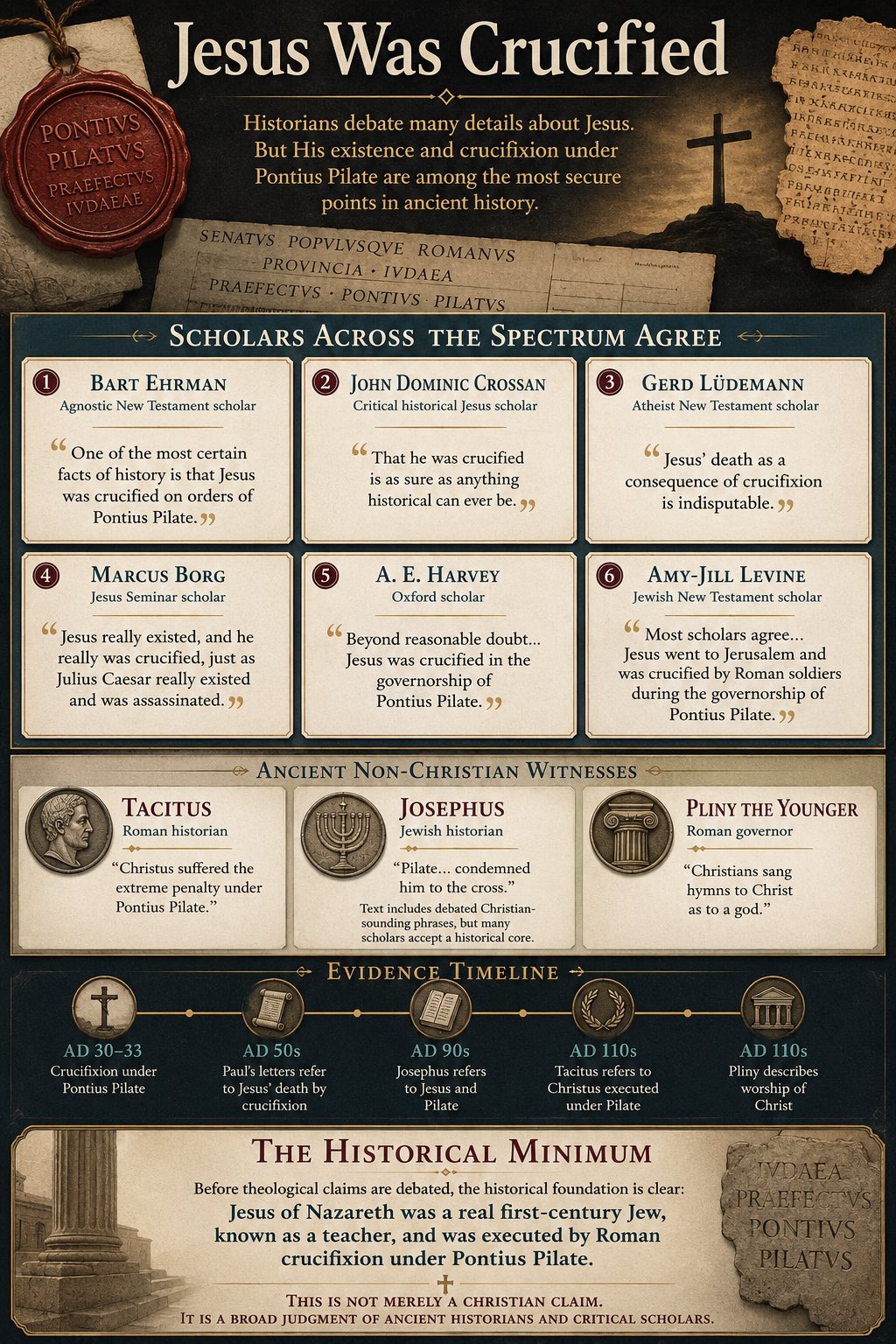
A visual summary of the early, public, and non-Christian evidence that Jesus was executed by Roman crucifixion.
Qur’an 4:157 says they did not kill or crucify Jesus, but that it was made to appear so to them. Later tafsir commonly develops substitution explanations, while some modern discussions explore minority readings of the verse.
Paul, Acts, Tacitus, Josephus, later Jewish tradition, and critical scholars across theological lines treat Jesus’ crucifixion as a fact requiring explanation. A denial must explain why both Christian and non-Christian streams remember Jesus’ execution.
Full rebuttal
The Christian claim begins with Scripture, but it is also historically public: Paul, Acts, Roman testimony, Jewish tradition, and critical scholarship all treat Jesus’ execution as a datum to explain.
The case does not begin with a late legend but with a creed older than the documents that contain it. In 1 Corinthians 15 Paul says he “passed on” what he had “received,” the technical language of handing on fixed tradition, and then names what he received: Christ died for our sins, was buried, was raised, and appeared. Scholars across the spectrum date this formula to within a few years of the events, traced back to the Jerusalem apostles. Jesus’ death is not an optional later layer painted over a peaceful teacher; it stands at the very head of the oldest summary of the faith we possess.
That centrality runs through the earliest material. The hymn Paul quotes in Philippians presses all the way down to “death on a cross.” Far from concealing the execution, the first Christians made it the heart of the message, which is precisely what a fabricator would not do.
Crucifixion was a Roman spectacle, carried out in the open as a deterrent. The earliest preaching treats it exactly that way. In Acts, Peter stands up in Jerusalem, the very city where it happened, mere weeks after it happened, and tells the crowd that this same Jesus, attested by God among them “as you yourselves know,” was handed over and put to death by being nailed to the cross. He appeals to what his hearers already witnessed.
You cannot preach a fictional public execution to the population that supposedly saw it and expect to be believed. The setting itself functions as a kind of evidence: the claim was made early, locally, and to people in a position to falsify it.
Non-Christian witnesses cannot prove the resurrection, but they can show the execution was no in-house Christian invention.
None of these writers wished the Christian message well. That is exactly why their agreement on the fact of the execution carries weight.
Even thoroughly skeptical historians regard the crucifixion as among the most secure facts about Jesus. John Dominic Crossan, no defender of orthodoxy, has called it about as certain as anything in ancient history; Bart Ehrman, an agnostic, treats it as effectively beyond dispute. The reason is the criterion of embarrassment. A crucified messiah was a contradiction in terms to a first-century Jew. The law pronounced anyone hung on a tree to be under God’s curse, and “Christ crucified” struck the wider world as foolishness. No one courting converts invents a savior who dies the single most shameful death the empire could devise. The church proclaimed it because it happened.
Two denials run against this.
The crucifixion is the firm ground on which the next question stands: why the tomb was empty and what the witnesses claimed to see.
Christus, from whom the name had its origin, suffered the extreme penalty during the reign of Tiberius at the hands of one of our procurators, Pontius Pilatus
Bottom line
Jesus’ death by crucifixion is not a fragile piece of Christian public relations; it is one of the best-attested events of antiquity. The earliest creed puts it first, the apostles preached it openly in the city where it happened, and even hostile Roman and Jewish sources record it. Movements do not invent a crucified messiah, a scandal to Jew and Gentile alike. The cross is where serious conversation about Jesus must begin, not end.
Christian resurrection hope depends on the same Jesus who was crucified being raised bodily. Luke, John, Paul, and Acts point to continuity between the dead Jesus and the risen Lord.
The Gospel writers go out of their way to rule out a phantom. When the disciples think they are seeing a spirit, Luke records Jesus answering the fear head-on: “a spirit does not have flesh and bones, as you see I have.” He shows them his hands and feet, invites them to touch him, and eats a piece of broiled fish in front of them. The scene is not decorative; it is deliberately anti-ghost.
The point throughout is continuity. The body that is raised carries the marks of the body that was crucified: the same hands, the same feet, the same wounds. This is why the resurrection is the natural sequel to the crucifixion: not a different being who replaces Jesus, but the very Jesus who died, now alive.
John tells the story of Thomas, who refuses to believe on report and demands to see the wounds for himself. A week later Jesus offers him exactly that, and Thomas answers with the highest confession in the Gospel: “My Lord and my God!” A bodily encounter produces worship of the risen Christ as God.
These were not fleeting private impressions. The appearances are repeated, physical, and communal: meals shared, conversations held, wounds inspected, a commission given. Whatever else the first witnesses were doing, they were not describing a comforting inner feeling. They claimed to have met a person.
The earliest written testimony, Paul’s creed in 1 Corinthians 15, says Christ “was buried” and “was raised.” The body that went into the tomb is the body that came out, now the “firstfruits” of a coming harvest. Paul stakes the entire Christian hope on it: because Jesus was raised bodily, those who belong to him will be too.
The usual objection cites Paul’s own words: he speaks of a “spiritual body,” and says “flesh and blood cannot inherit the kingdom of God.” But this misreads the grammar. Paul contrasts a “natural body” with a “spiritual body,” and as many New Testament scholars note, those adjectives name the animating power, not the material. A “natural body” is not made of soul; just so, a “spiritual body” is not made of spirit; it is a body fully animated and empowered by the Holy Spirit, imperishable and glorious. As for “flesh and blood,” the phrase is a Jewish idiom for frail, mortal humanity. Paul’s very next lines call for “the perishable” to be “clothed with the imperishable, and the mortal with immortality.” That is transformation of the body, not escape from it.
Two careful versions of this objection deserve a careful answer.
Some groups teach that Jesus was raised as a spirit creature, his fleshly body disposed of, and that the appearances were materializations. This reads the texts against their grain: the wounds, the eating, the “flesh and bones,” and the empty tomb. The full response is at Jesus rose as a spirit creature.
Other readers, more sympathetic, propose that the first Christians had visionary experiences later dressed up in physical detail. But a vision does not empty a tomb, and Paul, who lists his own encounter alongside the rest, grounds the believer’s future bodily resurrection in the pattern of Jesus’ own. Strip the body out and the physical scenes, the empty grave, and the entire logic of 1 Corinthians 15 become inexplicable.
Concede what is true: Paul does not teach a mere resuscitation of a corpse that will die again, but a transformed, glorified body. Transformed, however, is not the same as immaterial. The risen Jesus is continuous with the crucified Jesus: changed, deathless, but unmistakably him. This is what makes the public apostolic witness a claim about history rather than private comfort.
Bottom line
The New Testament will not let the resurrection dissolve into metaphor or a recreated spirit. The risen Jesus shows the wounds of the cross, is touched, eats, and is worshiped as Lord and God. Paul’s “spiritual body” means a body empowered by the Spirit and raised imperishable: transformed, not dematerialized. The same Jesus who was crucified is the one who stood among them alive, and that bodily reality is the foundation of Christian hope.
Official source
Quran.com presentation of the Qur’an with English translation support, used for mainstream Islamic references.
The Qur’an, Quran.com, accessed June 16, 2026.
Open sourceReference
Classical Sunni tafsir used to represent traditional interpretation of Qur’anic passages.
Ibn Kathir, Tafsir on Qur’an 4:157, Quran.com, accessed June 16, 2026.
Open sourceSecondary context
Muslim scholarly discussion of Qur’an 4:157 and the death of Jesus.
Mahmoud M. Ayoub, “The Death of Jesus: Reality or Delusion? A Study of the Death of Jesus in Tafsir Literature,” The Muslim World 70, no. 2, 1980.
Primary source
Roman historical reference to Christus suffering under Pontius Pilate.
Tacitus, Annals 15.44.
Primary source
Jewish historical reference to Jesus, handled with the standard interpolation caution.
Josephus, Antiquities of the Jews 18.63-64.
Primary source
Later Jewish polemical memory of Jesus’ execution.
Babylonian Talmud, Sanhedrin 43a, Sefaria, accessed June 16, 2026.
Open sourceSecondary context
Critical historical source affirming Jesus’ existence and crucifixion.
Bart D. Ehrman, Did Jesus Exist?: The Historical Argument for Jesus of Nazareth, HarperOne, 2012.
Secondary context
Critical historical-Jesus source that treats the crucifixion as historically secure.
John Dominic Crossan, Jesus: A Revolutionary Biography, HarperOne, 1994.
Reference
BibleRef provides reference material for Scripture passages.
BibleRef, accessed June 16, 2026.
Open sourceSecondary context
Long-form apologetics interview addressing common atheist objections about creation, morality, religious exclusivity, Jesus’ existence, and the resurrection.
Wes Huff, “Wes Huff Debunks TOP 7 Atheist Arguments w/ John Lovell,” The John Lovell Show, Warrior Poet Society, YouTube, November 6, 2025, accessed June 16, 2026.
Open sourceSecondary context
Secondary Christian apologetics source for historical resurrection arguments.
Gary R. Habermas and Michael R. Licona, The Case for the Resurrection of Jesus, Kregel Publications, 2004.
Secondary context
Apologetics interview segment where Wes Huff gives brief responses to common objections about evil, hell, science, Scripture, Christian failure, and the resurrection.
Wes Huff, “Rapid-Fire Apologetics: Wes Huff Answers 10 Tough Questions About the Bible and Theology,” The Gospel Coalition, YouTube, August 25, 2025, accessed June 16, 2026.
Open source