Official source
The Qur'an
Quran.com presentation of the Qur’an with English translation support, used for mainstream Islamic references.
The Qur’an, Quran.com, accessed June 16, 2026.
Open sourceObjection
Jesus was a Muslim because he submitted to God, and Muslims follow Jesus better than Christians do.
If Muslim only means one who submits to God, Christians agree that Jesus submitted perfectly to the Father. But if Islam means the religion of Muhammad, the Qur’an, and the sunnah, Jesus lived before it and taught claims about himself, the Father, the cross, and the gospel that Islam later denies.
Visual summary
Concise visual summaries for teaching, discussion, and sharing.
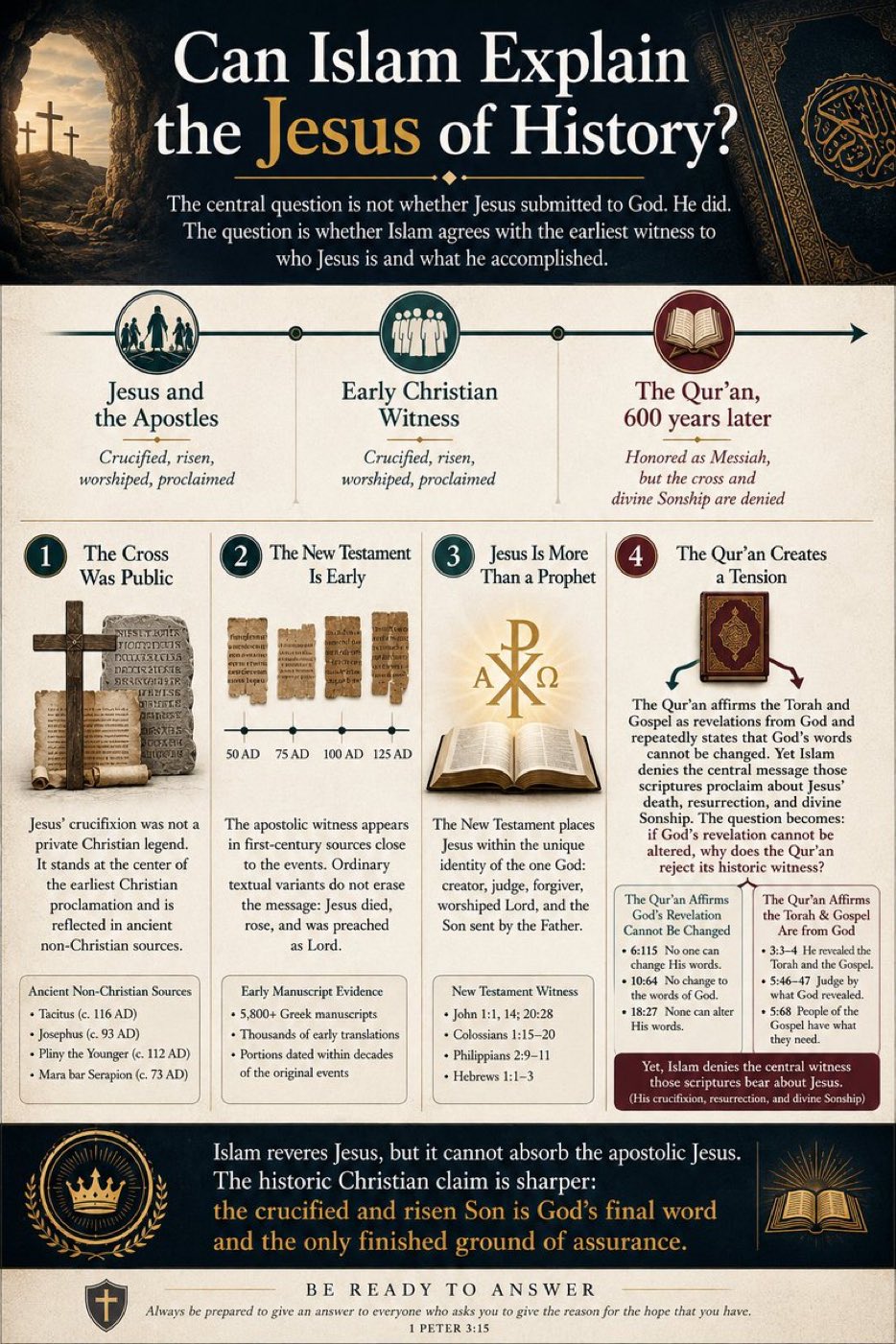
A visual summary of the historical question beneath the claim that Jesus was Muslim: whether Islam agrees with the earliest witnesses about who Jesus is and what he accomplished.
The word “Muslim” can be used in two different ways. If it means simply “one who submits to God,” then Christians can gladly say Jesus submitted perfectly to the Father. He obeyed, prayed, trusted, and fulfilled his mission without sin.
But that is not enough to prove Islam. If “Muslim” means a follower of the Qur’an, Muhammad, and Islamic teaching as a religious system, then the statement becomes historically anachronistic. Jesus lived six centuries before Muhammad. The real question is not whether Jesus submitted to God, but what Jesus taught and whether Muhammad’s later message agrees with it.
It is possible to find surface similarities between Jesus and Muslim practice: Jesus prayed, fasted, worshiped the one God, and lived with reverence. But gestures do not settle identity. A person can prostrate and still be wrong about who Jesus is. A person can avoid pork and still reject the gospel Jesus entrusted to his apostles.
The source question matters. If a Muslim appeals to the Bible to show that Jesus prayed or lived a certain way, then the same Bible must be allowed to speak when Jesus forgives sins, receives worship, calls God his Father, predicts his death and resurrection, and sends his disciples to proclaim him. If the Bible is removed, Islam has very little concrete material about Jesus’ daily teaching and practice.
The New Testament does not present Jesus as a generic submitter whose message can be replaced by a later prophet. He is the Son who uniquely reveals the Father, the Word made flesh, the one Thomas confesses as “my Lord and my God,” and the crucified and risen Messiah who sends witnesses to the nations.
That is why the disagreement is not solved by saying Jesus was monotheistic. Christians are monotheists too. The disputed questions are sharper: Did Jesus die and rise? Is he the eternal Son? Did he send the Spirit to guide the apostolic witness? Is the gospel final, or can a later message deny the cross and redefine Jesus? On those questions, Islam and the New Testament do not say the same thing.
Jesus did not leave a Qur’an, but he did leave authorized witnesses. He taught publicly, chose apostles, promised the Holy Spirit would bring his words to remembrance, and commissioned them to bear witness. The Christian claim is not that later church preference outranks Jesus; it is that the apostolic witness is how Jesus made his teaching known.
So the fair invitation is simple: read Jesus in the sources that preserve his words and deeds, and let his full identity speak. A Jesus reduced to “a prophet who submitted” is smaller than the Jesus of the Gospels.
Full rebuttal
Christian confession that Jesus is God does not begin by adding a second god to Israel’s God. It arises because the New Testament places Jesus inside the unique identity of the one Creator, treating him as the agent of creation, the bearer of the divine name, and the rightful recipient of worship, while still distinguishing him from the Father.
The decisive issue is not whether the word Trinity appears in a verse, or whether Jesus ever recites the sentence “I am God.” The question is whether the New Testament places Jesus within the unique identity of the one God of Israel; the God who alone created all things, who alone bears the divine name, and who alone is worshiped.
Richard Bauckham calls this a Christology of divine identity: the earliest Christians did not first define an abstract divine nature and then ask whether Jesus possessed it. They identified Jesus by what only God does and who only God is; creating and sustaining all things, ruling from the heavenly throne, bearing the name above every name, and they did this while remaining Jewish monotheists. Reading the texts this way keeps us from a fruitless hunt for a single proof verse and lets the whole pattern speak.
That also puts the familiar Liar, Lunatic, or Lord argument in its proper place. It is not a substitute for exegesis or history. It asks whether “great teacher but not Lord” still makes sense once the New Testament portrait of Jesus is actually in view.
John opens by saying the Word was with God and was God, then says all things were made through him, and finally that the Word became flesh as Jesus. The two clauses are deliberate. “With God” keeps the Word personally distinct from the Father; “was God” refuses to make him anything less than fully divine. Christian doctrine simply preserves both halves: the Son is not the Father, and the Son is not a creature.
Some translations render the last clause “the Word was a god,” a move examined in John 1:1 does not say “a god”. But the wider sentence settles the sense: the one through whom all things were made cannot himself be one of the made things. John 8:58 points the same direction, where Jesus says that before Abraham was born, “I am”; language that echoes the LORD’s own self-identification (“I am he”) in Isaiah, and which his hearers treat as a divine claim worth stoning him for.
The sharpest line in Jewish monotheism runs between the Creator and everything created. The New Testament repeatedly puts Jesus on the Creator side of it:
This is why “firstborn” and “image of the invisible God” cannot be read as “first creature.” The same passage that uses those words makes Jesus the source, not a product, of creation.
Do not let the conversation be narrowed to one modern sentence, as though Jesus had to say the exact words “I am God; worship me” before the evidence counts. The Synoptic Gospels often show his identity by what he does, how he speaks, and where he places himself in Israel’s story.
Mark gives several examples. Jesus calls twelve disciples, standing over the restored people of God rather than simply taking one tribal seat among them. In the vineyard parable, he distinguishes himself from the servants sent before him and identifies himself as the beloved son sent by the owner after the prophets. He knows what opponents are reasoning in their hearts, a knowledge Scripture reserves to God, and he stills the sea in a way that echoes Psalm 107, where the LORD quiets the storm and delivers those who cry to him.
None of these replaces the direct texts in John, Paul, Hebrews, and Revelation. They show that the divine-identity pattern is not limited to one Gospel or one proof verse.
Larry Hurtado documents that the worship of Jesus; prayer to him, hymns about him, calling on his name, baptizing into him; is present astonishingly early, among Jewish believers who would not bow to any creature, and not as a slow later development. That devotional pattern is itself evidence of how the first Christians understood him.
Scripture shows the same instinct. John says Thomas answered Jesus directly, “My Lord and my God.” This is not a stray exclamation into the air. When apostles or angels are wrongly treated as divine, they refuse the honor and redirect it to God; Herod is judged for receiving divine praise. Jesus does not correct Thomas. He receives the confession and commends the faith that sees him truly.
Revelation makes the same point in another register. Jesus calls himself “the First and the Last,” a title the LORD claims for himself in Isaiah, and the Lamb receives creation-wide worship with the One on the throne.
Several texts sharpen the same point from another angle. In Revelation 5, every creature in heaven, on earth, under the earth, and in the sea gives blessing, honor, glory, and might to the One on the throne and to the Lamb. The Lamb is not listed as one more creature joining the song. He receives the worship of the whole creation with God.
Jesus also asks the Father to glorify him with the glory he had with the Father before the world existed, while Isaiah says the LORD does not give his glory to another. John then says Isaiah saw Jesus’ glory when he quotes Isaiah’s temple vision. The apostolic writers are not embarrassed to speak this way because they are not giving divine honor to a creature. They are confessing the Son who shares the Father’s glory while remaining personally distinct from the Father.
Titus 2:13 and 2 Peter 1:1 compress the same confession into doxological language about Jesus Christ as God and Savior. The natural reading is strengthened by comparison with 2 Peter 1:11, where “Lord and Savior” plainly names one person, Jesus Christ. Grammar should not be oversold as a magic formula that ends every dispute, but in context the titles fit the wider pattern: Jesus receives the names, works, glory, worship, and saving role of the one God.
By this point, the argument should be read cumulatively. The New Testament does not merely say isolated exalted things about Jesus. It joins his claims, actions, worship, apostolic confession, and Old Testament titles into one pattern: Jesus is personally distinct from the Father, yet he receives what belongs to God alone.
The case for Christ’s deity is woven through the New Testament rather than resting on a single proof text.
Claims and actions
Jesus speaks with divine authority and does what Scripture attributes to God alone.
Worship and confession
Jesus receives worship and direct divine confession rather than redirecting that honor away from himself.
Titles and testimony
Apostolic writers apply divine names, roles, and Old Testament categories to Jesus while maintaining monotheism.
The conclusion is not built from one verse alone. It comes from the repeated New Testament pattern of giving Jesus God’s works, names, throne, glory, and worship.
The later creeds did not invent worship of Jesus. They gave careful vocabulary to a devotion already present in the church’s earliest life. Ignatius of Antioch, writing near the beginning of the second century, speaks of Jesus Christ as God while also distinguishing him from the Father. Pliny the Younger, a Roman governor hostile to Christian worship, reported around the same period that Christians gathered to sing to Christ as to a god.
That evidence does not replace the biblical case. It answers the historical claim that Jesus’ deity was a late fourth-century corruption. Before Nicaea, Christians were already worshiping Christ, and outsiders already recognized that worship as directed to him.
The strongest objection gathers the texts where Jesus looks subordinate: he says “the Father is greater than I,” he does not know the day or hour, he prays, he is “sent,” and he will be “subjected” to the Father. If he is God, how can any of this be true?
Two distinctions carry the weight:
Read this way, the subordination texts are not embarrassments to be explained away. They are precisely what you would expect if the eternal Son truly became one of us, and the same Gospels that record his prayers also record Thomas worshiping him and John calling him God. Related objections are handled at Jesus never claimed to be God and Jesus is Michael the archangel.
Bottom line
The case that Jesus is God is not built on a lone proof text or on the word Trinity. It is built on a consistent pattern: the New Testament gives Jesus the works, names, throne, and worship that belong to the one Creator, while still distinguishing him from the Father. The verses where he prays or defers fit a real incarnation and a real distinction of persons; they never reduce him to a creature. To meet Jesus in these pages is to meet the LORD made flesh.
The Christian claim begins with Scripture, but it is also historically public: Paul, Acts, Roman testimony, Jewish tradition, and critical scholarship all treat Jesus’ execution as a datum to explain.
The case does not begin with a late legend but with a creed older than the documents that contain it. In 1 Corinthians 15 Paul says he “passed on” what he had “received,” the technical language of handing on fixed tradition, and then names what he received: Christ died for our sins, was buried, was raised, and appeared. Scholars across the spectrum date this formula to within a few years of the events, traced back to the Jerusalem apostles. Jesus’ death is not an optional later layer painted over a peaceful teacher; it stands at the very head of the oldest summary of the faith we possess.
That centrality runs through the earliest material. The hymn Paul quotes in Philippians presses all the way down to “death on a cross.” Far from concealing the execution, the first Christians made it the heart of the message, which is precisely what a fabricator would not do.
Crucifixion was a Roman spectacle, carried out in the open as a deterrent. The earliest preaching treats it exactly that way. In Acts, Peter stands up in Jerusalem, the very city where it happened, mere weeks after it happened, and tells the crowd that this same Jesus, attested by God among them “as you yourselves know,” was handed over and put to death by being nailed to the cross. He appeals to what his hearers already witnessed.
You cannot preach a fictional public execution to the population that supposedly saw it and expect to be believed. The setting itself functions as a kind of evidence: the claim was made early, locally, and to people in a position to falsify it.
Non-Christian witnesses cannot prove the resurrection, but they can show the execution was no in-house Christian invention.
None of these writers wished the Christian message well. That is exactly why their agreement on the fact of the execution carries weight.
Even thoroughly skeptical historians regard the crucifixion as among the most secure facts about Jesus. John Dominic Crossan, no defender of orthodoxy, has called it about as certain as anything in ancient history; Bart Ehrman, an agnostic, treats it as effectively beyond dispute. The reason is the criterion of embarrassment. A crucified messiah was a contradiction in terms to a first-century Jew. The law pronounced anyone hung on a tree to be under God’s curse, and “Christ crucified” struck the wider world as foolishness. No one courting converts invents a savior who dies the single most shameful death the empire could devise. The church proclaimed it because it happened.
Two denials run against this.
The crucifixion is the firm ground on which the next question stands: why the tomb was empty and what the witnesses claimed to see.
Christus, from whom the name had its origin, suffered the extreme penalty during the reign of Tiberius at the hands of one of our procurators, Pontius Pilatus
Bottom line
Jesus’ death by crucifixion is not a fragile piece of Christian public relations; it is one of the best-attested events of antiquity. The earliest creed puts it first, the apostles preached it openly in the city where it happened, and even hostile Roman and Jewish sources record it. Movements do not invent a crucified messiah, a scandal to Jew and Gentile alike. The cross is where serious conversation about Jesus must begin, not end.
Christian testing of later claims is not hostility to revelation. It is obedience to the apostolic warnings about contrary gospels and to the faith entrusted once for all to the saints as a deposit to be guarded, climaxing in God’s final word in the Son, with grace as its non-negotiable core.
Concede the legitimate worry first: a faith that never lets anything new be said can calcify into mere traditionalism. But that is not what is at stake here. The New Testament does not describe the gospel as an evolving conversation. It describes it as a deposit: something received, entrusted, and to be guarded intact.
Jude makes the point in a single phrase: “the faith which was once delivered unto the saints.” The word translated “once” means once-for-all, not once-upon-a-time. Paul tells Timothy to “hold fast the form of sound words” and to “keep” the “good thing which was committed unto thee.” The posture toward the apostolic gospel is custodial: you do not improve a deposit, you protect it.
This is why the question to ask of any later movement is not whether it is sincere, growing, or spiritually moving, but whether its message is the same gospel the apostles delivered: the gospel Paul says he received and passed on, “how that Christ died for our sins according to the scriptures… and that he rose again the third day.”
Paul anticipates the very move later claims rely on. He does not say “reject any rival preacher because he is less credentialed than I am.” He says the opposite: “though we, or an angel from heaven, preach any other gospel unto you than that which we have preached unto you, let him be accursed.” He stakes the test on content, not credentials, and he disqualifies even himself and even an angel if the message changes.
That is decisive for how to weigh an impressive origin story. A recovered set of plates, a recited revelation of surpassing beauty, an angelic messenger: none of these is the criterion. The criterion is whether the resulting gospel agrees with the one already given. A book offered as another testament alongside the Bible, or a message claiming to restore truths the church supposedly lost, must be measured by that standard, however moving its arrival. The argument over the testing framework itself sets this out in full. Here the point is narrower and sharper: even heaven’s own angel would not be exempt.
Not every disagreement changes the gospel. People can differ on church order, prophecy, and a hundred secondary matters while preaching the same good news. So it matters to name what cannot move: the basis of salvation.
Paul draws the line at grace. “By grace are ye saved through faith; and that not of yourselves: it is the gift of God: not of works, lest any man should boast.” He puts the stakes starkly: “if righteousness come by the law, then Christ is dead in vain.” A message that leaves the words grace, Christ, and faith in place but relocates final salvation onto human merit, ritual attainment, or a ladder of exaltation earned by works has not added detail to the gospel. It has swapped out its foundation. That is precisely the kind of change Paul calls “another gospel.”
The strongest objection is not that the apostles were unimpressive but that finality is arbitrary: God spoke progressively through Moses and then the prophets, so why assume the installments end with the apostles? Isn’t “no more revelation” just a door slammed to protect the status quo, the same instinct that, the claim goes, drove the church to lose plain and precious truths?
The answer is that the finality is not arbitrary; it is built into how the story was always told.
So rejecting a contrary gospel is not fear of God speaking again. It is taking seriously that God has spoken his final word in the Son, and that the faith built on that word was delivered to the saints once for all.
Bottom line
The apostolic gospel is a deposit delivered once for all, not a draft awaiting revision. Paul ties the test to content, not credentials. Even an angel preaching another gospel is accursed. And he draws the immovable line at grace: relocate salvation onto human merit and you have changed the gospel, not enriched it. Revelation reaches its goal in the Son, after whom the task is to guard the deposit, not await the next installment. Measure every later claim by that gospel, and reject what contradicts it however it arrived.
The Bible does not ask believers to accept every claimant who reports a revelation. It supplies public tests for agreement with prior revelation, fidelity to the true God, and the fulfillment of what is predicted, and commands that they be applied consistently rather than waived for an impressive sign or a moving testimony.
Start by clearing away a caricature. Testing a revelation claim is not the reflex of a closed mind; it is a biblical command. Paul tells the Thessalonians to “prove all things; hold fast that which is good.” John says “believe not every spirit, but try the spirits.” Luke praises the Bereans for examining even an apostle’s preaching against the Scriptures. Discernment is obedience, not suspicion.
The tests themselves are not improvised. The Scriptures give three:
Notice that all three are public. None of them asks how sincerely the claimant believes, how moving the experience felt, or how rapidly the movement grew. They ask whether the claim is true and where it leads.
The most important test is also the most counterintuitive. In Deuteronomy 13, Moses imagines a prophet whose sign or wonder actually comes true, and then says, “let us go after other gods.” The verdict is unflinching: do not heed him, “for the LORD your God putteth you to proof.” A genuine wonder does not license a message that turns you from the true God; if anything, it becomes the test.
This settles a move that recurs in almost every later claim: but there were miracles, healings, a transformed life, a beautiful book. Grant the experience for the sake of argument. The framework still asks the prior question: toward which God, and which gospel, does the claim lead? Paul makes the same point at full strength: “though we, or an angel from heaven, preach any other gospel unto you… let him be accursed.” He even warns that “Satan himself is transformed into an angel of light.” An angelic visitation, a recovered record, or a heavenly messenger does not exempt a message from the test; it raises the stakes of applying it. This is why a claimed restoration after a total apostasy cannot rest on the impressiveness of its origin story alone.
Deuteronomy 18 gives the bluntest test of all. If a prophet “speaketh in the name of the LORD” and “the thing follow not, nor come to pass,” then “the LORD hath not spoken” it, and the people need not fear him. A datable, falsifiable prediction that fails is not a minor blemish on an otherwise reliable prophet; in the Torah’s own terms it marks the prophet as one who “hath spoken it presumptuously.”
Applied consistently, this test is decisive against movements that staked their authority on specific, failed predictions, especially the claim that Christ’s kingdom began invisibly in 1914, which descends from a chain of revised dates. The point is not to mock; it is to take the prophet’s own claim seriously enough to check it, exactly as Moses required.
The serious objection is that the whole framework begs the question: Christians simply assume their revelation is the standard and then judge every rival by it. Doesn’t every faith do that, and don’t the tests just hand victory to whoever owns the measuring stick?
Three replies keep the framework honest:
So the door is not arbitrarily shut to new revelation. It is the door God himself installed and, in the Son, decisively closed, which is the argument that the apostolic gospel is final.
When a prophet speaketh in the name of the LORD, if the thing follow not, nor come to pass, that is the thing which the LORD hath not spoken; the prophet hath spoken it presumptuously, thou shalt not be afraid of him.
Bottom line
Scripture never asks believers to accept a revelation claim because it came with signs, sincerity, or a stirring story. It gives three public tests: agreement with prior revelation, direction toward the true God, and fulfilled prediction. It commands that they be applied consistently, even to an angel and even to ourselves. A true wonder cannot license a message that turns you from the LORD, and a failed prophecy disqualifies the prophet. Apply the tests evenly, and let the claim stand or fall on them.
But Muslim just means one who submits to God. Why object?
Christians do not object to that definition by itself. Jesus submitted perfectly to the Father. The problem comes when that broad word is used to smuggle in the later claims of Islam. Submission to God does not prove that Jesus taught the Qur’an’s view of the cross, Muhammad, or his own identity.
Muslims imitate Jesus by prostrating and obeying one God. Doesn’t that show continuity?
Similar practices can be real without proving doctrinal continuity. The question is what Jesus taught about himself, his death, his resurrection, and the Father. The same biblical sources that show Jesus praying also show him receiving divine honor and sending his disciples to preach his death and resurrection.
Wasn’t Jesus sent only to Israel?
Jesus’ earthly mission begins with Israel, but the biblical promise was always larger. The risen Jesus sends the apostles to all nations, and Luke says the Scriptures anticipated repentance and forgiveness being proclaimed in his name to all nations. Being sent first to Israel does not reduce Jesus to an Israel-only figure.
Common mistakes
Bottom line
Jesus submitted perfectly to God, but that does not make him a follower of Muhammad’s later religion. The decisive question is not whether Jesus prayed or honored the one God; Christians agree he did. The question is whether Islam agrees with Jesus’ own witness about his identity, cross, resurrection, and gospel. On those central claims, the New Testament Jesus is not the Jesus Islam requires.
The objection at its strongest
Islam presents itself not as a new religion but as the restored religion of all prophets. Abraham, Moses, Jesus, and Muhammad all submitted to the one God; in that broad sense they were all Muslim. Jesus prayed, fasted, worshiped one God, rejected idolatry, and did not teach later church doctrines in Islamic telling. Muslims may also point to practices such as prostration, modesty, dietary seriousness, and reverence for Mary as evidence that Muslim life looks closer to Jesus than modern Christianity does.
The claim is therefore not only chronological. It is a claim about continuity: Christians changed Jesus into God and built a religion around Paul and church councils, while Islam preserves Jesus’ original submission to Allah.
Official source
Quran.com presentation of the Qur’an with English translation support, used for mainstream Islamic references.
The Qur’an, Quran.com, accessed June 16, 2026.
Open sourceSecondary context
Christian apologetics treatment of Islam and Christianity by a former Muslim.
Nabeel Qureshi, No God but One: Allah or Jesus?, Zondervan, 2016.
Reference
BibleRef provides reference material for Scripture passages.
BibleRef, accessed June 16, 2026.
Open sourceSecondary context
Scholarly work on early divine-identity Christology and Jewish monotheism.
Richard Bauckham, Jesus and the God of Israel: God Crucified and Other Studies on the New Testament’s Christology of Divine Identity, Eerdmans, 2008.
Secondary context
Scholarly work on devotion to Jesus in earliest Christianity.
Larry W. Hurtado, Lord Jesus Christ: Devotion to Jesus in Earliest Christianity, Eerdmans, 2003.
Primary source
Early Christian witness to Jesus Christ as God and to pre-Nicene worship.
Ignatius of Antioch, Letter to the Ephesians 18.2; 20.2.
Primary source
Roman governor’s report that Christians sang hymns to Christ as to a god.
Pliny the Younger, Letters 10.96.
Secondary context
Video apologetics episode presenting four conversational cases for Christ’s deity from John 20, Titus 2, Jesus’ implicit claims, and early Christian worship.
Trent Horn, “My Four Favorite Ways to Prove Jesus is God,” The Counsel of Trent, YouTube, June 3, 2026, accessed June 18, 2026.
Open sourcePrimary source
Roman historical reference to Christus suffering under Pontius Pilate.
Tacitus, Annals 15.44.
Primary source
Jewish historical reference to Jesus, handled with the standard interpolation caution.
Josephus, Antiquities of the Jews 18.63-64.
Primary source
Later Jewish polemical memory of Jesus’ execution.
Babylonian Talmud, Sanhedrin 43a, Sefaria, accessed June 16, 2026.
Open sourceSecondary context
Critical historical source affirming Jesus’ existence and crucifixion.
Bart D. Ehrman, Did Jesus Exist?: The Historical Argument for Jesus of Nazareth, HarperOne, 2012.
Secondary context
Critical historical-Jesus source that treats the crucifixion as historically secure.
John Dominic Crossan, Jesus: A Revolutionary Biography, HarperOne, 1994.
Secondary context
Long-form apologetics interview addressing common atheist objections about creation, morality, religious exclusivity, Jesus’ existence, and the resurrection.
Wes Huff, “Wes Huff Debunks TOP 7 Atheist Arguments w/ John Lovell,” The John Lovell Show, Warrior Poet Society, YouTube, November 6, 2025, accessed June 16, 2026.
Open sourceOfficial source
Official Berean Bible terms for use and attribution of the Berean Standard Bible text.
Berean Bible, “Terms and Conditions,” accessed June 16, 2026.
Open sourceReference
Jewish Publication Society Tanakh translation context available through Sefaria.
Jewish Publication Society, “JPS Bible Translation Enters Digital Era with Sefaria,” accessed June 16, 2026.
Open source