Secondary context
The Case for the Resurrection of Jesus
Secondary Christian apologetics source for historical resurrection arguments.
Gary R. Habermas and Michael R. Licona, The Case for the Resurrection of Jesus, Kregel Publications, 2004.
Objection
Miracles are impossible because natural law rules out exceptions.
Natural laws describe ordinary creaturely patterns; they do not prove that the Creator cannot act within his creation.
Visual summary
Concise visual summaries for teaching, discussion, and sharing.
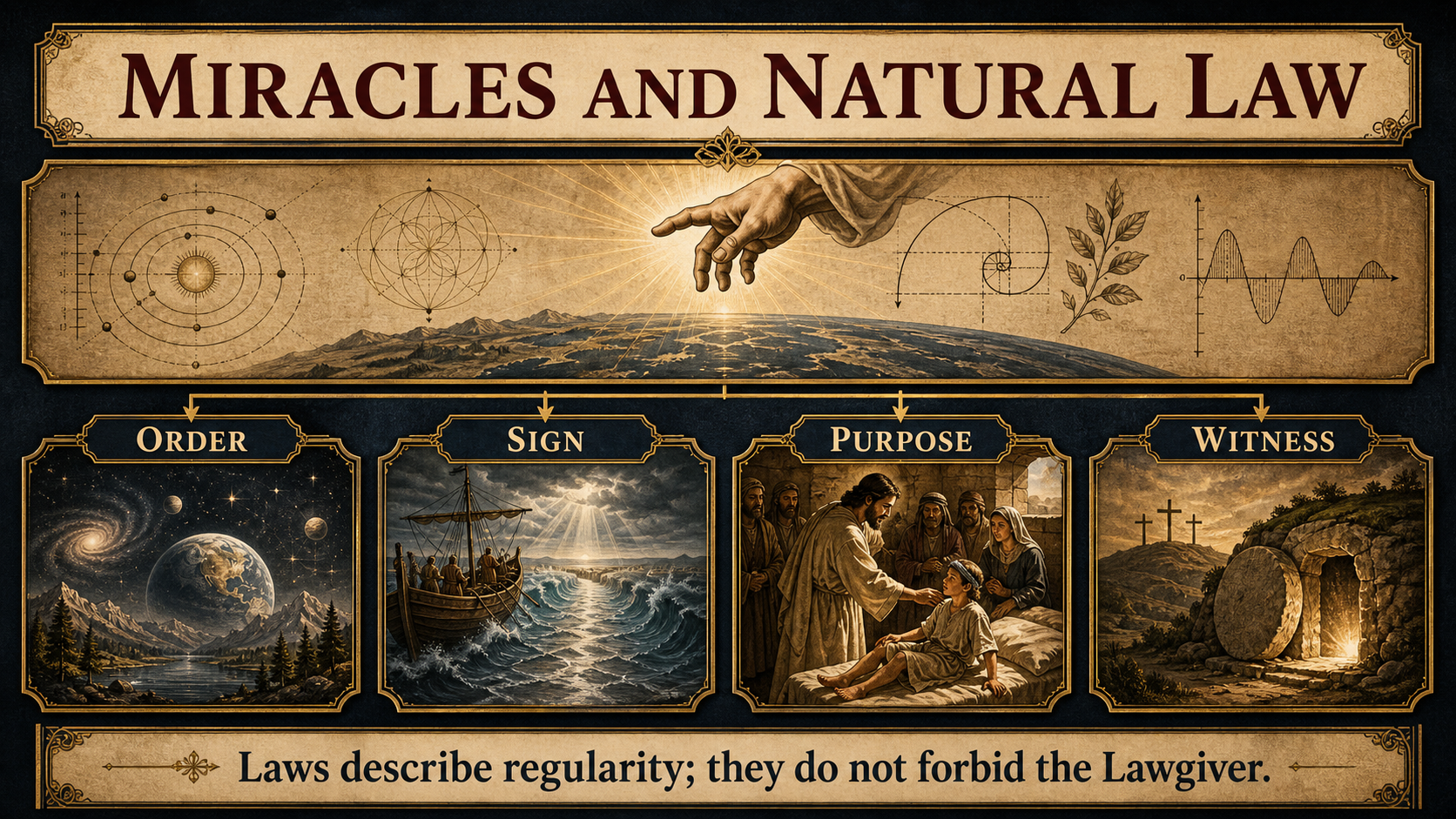
A visual distinction between regular natural order and purposeful divine signs within creation.
The skeptic is correct about a great deal. Most reported miracles do deserve hard scrutiny; credulity is not faith. The sciences have rightly displaced countless supernatural explanations, and a Christian should be glad of it rather than threatened by it. And miracles should be rare. If they happened constantly, they would not be signs at all, just weather. None of that is in dispute. The dispute is narrower and sharper: not whether miracles are common or easy to verify, but whether they are impossible in principle. The objection claims the latter, and that is the claim that quietly overreaches.
Define a miracle as “a violation of natural law,” then add “natural laws have no exceptions,” and you have proved miracles impossible, but only by assuming it. The second clause is not a discovery of science; it is a philosophical decision dressed as one. How would you test “nature is never acted upon from outside”? You would have to already know there is no God who might act. So the argument runs in a circle: it can only rule out miracles by first assuming the very thing in question, that nature is a closed system with no Author who can reach into it. That is a worldview claim, not a laboratory result, and it cannot be the premise of an argument meant to prove that worldview.
A natural law is a faithful description of how the world behaves when left to itself, when nothing outside the system intervenes. That is exactly why a miracle is not a “violation.” Consider an analogy:
In the same way, if God exists, his acting in the world is not nature malfunctioning but a personal agent introducing a cause beyond nature’s repertoire. Iron sinks unless a hand lifts it. The hand does not repeal the density of iron; it adds something the density of iron never ruled out. So the right question is never “can the laws be broken?” but “is there a Lawgiver free to act?” And that cannot be settled by the laws themselves.
This is the move that matters in a real conversation. The instant the objector retreats from “miracles are impossible” to “miracles are improbable,” the whole discussion changes character, from philosophy to history. A unique act of God is not the sort of thing you reproduce in a lab; it is the sort of thing you investigate the way a court investigates a singular past event, by weighing testimony, motive, and the best explanation of the agreed facts. So press toward the one miracle the whole faith stands or falls on: the resurrection. Ask not “do you believe in miracles?” but “what best explains the empty tomb, the transformed eyewitnesses, and the sudden rise of the church?” That is a question Hume’s argument was never built to answer.
Full rebuttal
The resurrection claim is historical, public, and central enough to be tested by witnesses, hostile response, and the earliest Christian proclamation.
Paul’s summary in 1 Corinthians 15 is not vague enthusiasm; it is a list. The risen Jesus appeared to Cephas, then to the Twelve, then to “more than five hundred brothers at once, most of whom are still living,” then to James, then to all the apostles, and last to Paul himself. Naming witnesses, and noting that most of the five hundred could still be questioned, is the language of testimony offered for examination, not legend told in the dark.
Because this creed traces back to within a few years of the crucifixion, it gives critics and believers alike a concrete, datable starting point. The “minimal facts” approach associated with Gary Habermas and Michael Licona builds precisely here: it reasons only from data granted by the broad range of scholars and asks which explanation best accounts for them.
The witnesses did not whisper their claim in safe company; they announced it in Jerusalem, before the same authorities who had just executed Jesus, and they would not stop. Hauled before the council and ordered to be silent, Peter and John answer that they “cannot stop speaking about what we have seen and heard.”
This matters because of what the apostles had to lose. People will die for a conviction they sincerely hold, that proves sincerity, not truth. But the apostles were not dying for a secondhand belief; they were dying for something they claimed to have seen with their own eyes. They were in a position to know whether it was a fraud, and they suffered and died as though it were not. Liars make poor martyrs.
Several features of the accounts are exactly what an invented story would have edited out.
The honest move is to lay the rival explanations on the table and weigh them against the same set of facts.
Bodily resurrection accounts for all of it at once; the empty tomb, the appearances to friends and enemies, and the sudden, costly, public proclamation in the very city of the execution. For the exegetical case that the resurrection was bodily, see the bodily resurrection of Jesus; for the objection that miracles cannot happen in principle, see miracles are impossible.
Bottom line
The resurrection is not offered as a private feeling but as public testimony: named witnesses, an early datable creed, bold proclamation in the city of the execution, and the costly endurance of people who claimed to have seen the risen Jesus. Any serious alternative has to explain that same body of evidence; the empty tomb, the converted enemies, the embarrassing details, the willingness to die. Bodily resurrection explains them together; that is why the witness belongs at the center.
Christian resurrection hope depends on the same Jesus who was crucified being raised bodily. Luke, John, Paul, and Acts point to continuity between the dead Jesus and the risen Lord.
The Gospel writers go out of their way to rule out a phantom. When the disciples think they are seeing a spirit, Luke records Jesus answering the fear head-on: “a spirit does not have flesh and bones, as you see I have.” He shows them his hands and feet, invites them to touch him, and eats a piece of broiled fish in front of them. The scene is not decorative; it is deliberately anti-ghost.
The point throughout is continuity. The body that is raised carries the marks of the body that was crucified: the same hands, the same feet, the same wounds. This is why the resurrection is the natural sequel to the crucifixion: not a different being who replaces Jesus, but the very Jesus who died, now alive.
John tells the story of Thomas, who refuses to believe on report and demands to see the wounds for himself. A week later Jesus offers him exactly that, and Thomas answers with the highest confession in the Gospel: “My Lord and my God!” A bodily encounter produces worship of the risen Christ as God.
These were not fleeting private impressions. The appearances are repeated, physical, and communal: meals shared, conversations held, wounds inspected, a commission given. Whatever else the first witnesses were doing, they were not describing a comforting inner feeling. They claimed to have met a person.
The earliest written testimony, Paul’s creed in 1 Corinthians 15, says Christ “was buried” and “was raised.” The body that went into the tomb is the body that came out, now the “firstfruits” of a coming harvest. Paul stakes the entire Christian hope on it: because Jesus was raised bodily, those who belong to him will be too.
The usual objection cites Paul’s own words: he speaks of a “spiritual body,” and says “flesh and blood cannot inherit the kingdom of God.” But this misreads the grammar. Paul contrasts a “natural body” with a “spiritual body,” and as many New Testament scholars note, those adjectives name the animating power, not the material. A “natural body” is not made of soul; just so, a “spiritual body” is not made of spirit; it is a body fully animated and empowered by the Holy Spirit, imperishable and glorious. As for “flesh and blood,” the phrase is a Jewish idiom for frail, mortal humanity. Paul’s very next lines call for “the perishable” to be “clothed with the imperishable, and the mortal with immortality.” That is transformation of the body, not escape from it.
Two careful versions of this objection deserve a careful answer.
Some groups teach that Jesus was raised as a spirit creature, his fleshly body disposed of, and that the appearances were materializations. This reads the texts against their grain: the wounds, the eating, the “flesh and bones,” and the empty tomb. The full response is at Jesus rose as a spirit creature.
Other readers, more sympathetic, propose that the first Christians had visionary experiences later dressed up in physical detail. But a vision does not empty a tomb, and Paul, who lists his own encounter alongside the rest, grounds the believer’s future bodily resurrection in the pattern of Jesus’ own. Strip the body out and the physical scenes, the empty grave, and the entire logic of 1 Corinthians 15 become inexplicable.
Concede what is true: Paul does not teach a mere resuscitation of a corpse that will die again, but a transformed, glorified body. Transformed, however, is not the same as immaterial. The risen Jesus is continuous with the crucified Jesus: changed, deathless, but unmistakably him. This is what makes the public apostolic witness a claim about history rather than private comfort.
Bottom line
The New Testament will not let the resurrection dissolve into metaphor or a recreated spirit. The risen Jesus shows the wounds of the cross, is touched, eats, and is worshiped as Lord and God. Paul’s “spiritual body” means a body empowered by the Spirit and raised imperishable: transformed, not dematerialized. The same Jesus who was crucified is the one who stood among them alive, and that bodily reality is the foundation of Christian hope.
By definition, a miracle does not happen as a result of a naturally repeating cause that can be measured and studied.
But every miracle ever investigated turned out to be natural. Doesn’t induction settle it?
Induction from past investigations is a fine reason to be cautious about new claims; it is not a reason to declare the next one impossible in advance. By that logic no one could ever rationally accept any genuinely unprecedented event, since it would always be outvoted by the more numerous ordinary cases. But “this has not happened before” is precisely what a unique act of God would look like, and the resurrection is offered not as one more faith healing but as a singular, public, evidence-bearing event. The track record of debunked miracles is real and useful, but it cannot examine the case before examining its evidence.
Isn’t Hume right that the wise proportion their belief to the evidence?
Yes, and proportioning belief to the evidence is exactly what the Christian asks for. The trouble is that Hume stacked the deck: he counted all of ordinary human experience as evidence against a miracle while refusing to let the specific testimony for it count for it. That is not weighing evidence; it is deciding the verdict before the trial. Properly applied, “follow the evidence” is the believer’s own principle. It is what leads from the empty tomb and the willingness of eyewitnesses to die for what they claimed to have seen, to the conclusion that something happened which natural causes do not explain.
If miracles are real, why don’t they show up under laboratory conditions?
Because a miracle is not a repeatable natural process; it is a free act of a personal agent, and persons do not perform on command. You cannot summon a friend’s act of kindness by controlling variables, and you cannot subpoena God into a test tube. As Stand to Reason puts it, the way to evaluate such a claim is not the laboratory but the methods of a courtroom: historical investigation of what actually happened on a particular occasion. Demanding lab-repeatability of a one-time personal act is a category mistake, not a refutation.
Common mistakes
Bottom line
“Miracles are impossible” only sounds like science; it is really a worldview asserted in advance. Natural laws describe how creation runs when left to itself, and an act of the Creator is not nature breaking but a free agent adding a cause the laws never ruled out. So the real question was never “can the laws be broken?” but “is there a God free to act?” That turns the whole debate into a question of historical evidence, where the resurrection is waiting.
The objection at its strongest
Every time we have carefully investigated a claimed miracle, whether a faith healing, a weeping statue, or a reported levitation, it has either dissolved under scrutiny or stayed permanently unverifiable. Meanwhile, the natural sciences have explained more and more of what people once attributed to the gods, with no remaining need for supernatural exceptions. Natural laws are not casual summaries; they are the most rigorously tested generalizations humans possess. A “miracle” is by definition a break in exactly those laws. So the rational person weighs it the way David Hume said: it is always more likely that the witness is mistaken or lying than that the firm course of nature was suspended. Belief in miracles is not a small leap; it is a vote against the entire weight of human experience.
Secondary context
Secondary Christian apologetics source for historical resurrection arguments.
Gary R. Habermas and Michael R. Licona, The Case for the Resurrection of Jesus, Kregel Publications, 2004.
Secondary context
Popular apologetics article distinguishing repeatable natural processes from unique miracle claims.
Amy K. Hall, “Why Science Does Not Disprove Miracles,” Stand to Reason, June 28, 2018, accessed June 16, 2026.
Open sourceSecondary context
Apologetics interview segment where Wes Huff gives brief responses to common objections about evil, hell, science, Scripture, Christian failure, and the resurrection.
Wes Huff, “Rapid-Fire Apologetics: Wes Huff Answers 10 Tough Questions About the Bible and Theology,” The Gospel Coalition, YouTube, August 25, 2025, accessed June 16, 2026.
Open sourceReference
BibleRef provides reference material for Scripture passages.
BibleRef, accessed June 16, 2026.
Open sourceSecondary context
Long-form apologetics interview addressing common atheist objections about creation, morality, religious exclusivity, Jesus’ existence, and the resurrection.
Wes Huff, “Wes Huff Debunks TOP 7 Atheist Arguments w/ John Lovell,” The John Lovell Show, Warrior Poet Society, YouTube, November 6, 2025, accessed June 16, 2026.
Open source