Secondary context
Is the Bible Pro-Slavery?
Popular apologetics article answering the objection that the Bible endorses slavery.
Jonathan Noyes, “Is the Bible Pro-Slavery?” Stand to Reason, July 3, 2024, accessed June 16, 2026.
Open sourceObjection
The Bible condones slavery, so it cannot be morally trustworthy.
The Bible regulates a fallen social institution in ancient contexts, condemns kidnapping, grounds human dignity in the image of God, and plants gospel truths that undermine slaveholding oppression.
Visual summary
Concise visual summaries for teaching, discussion, and sharing.
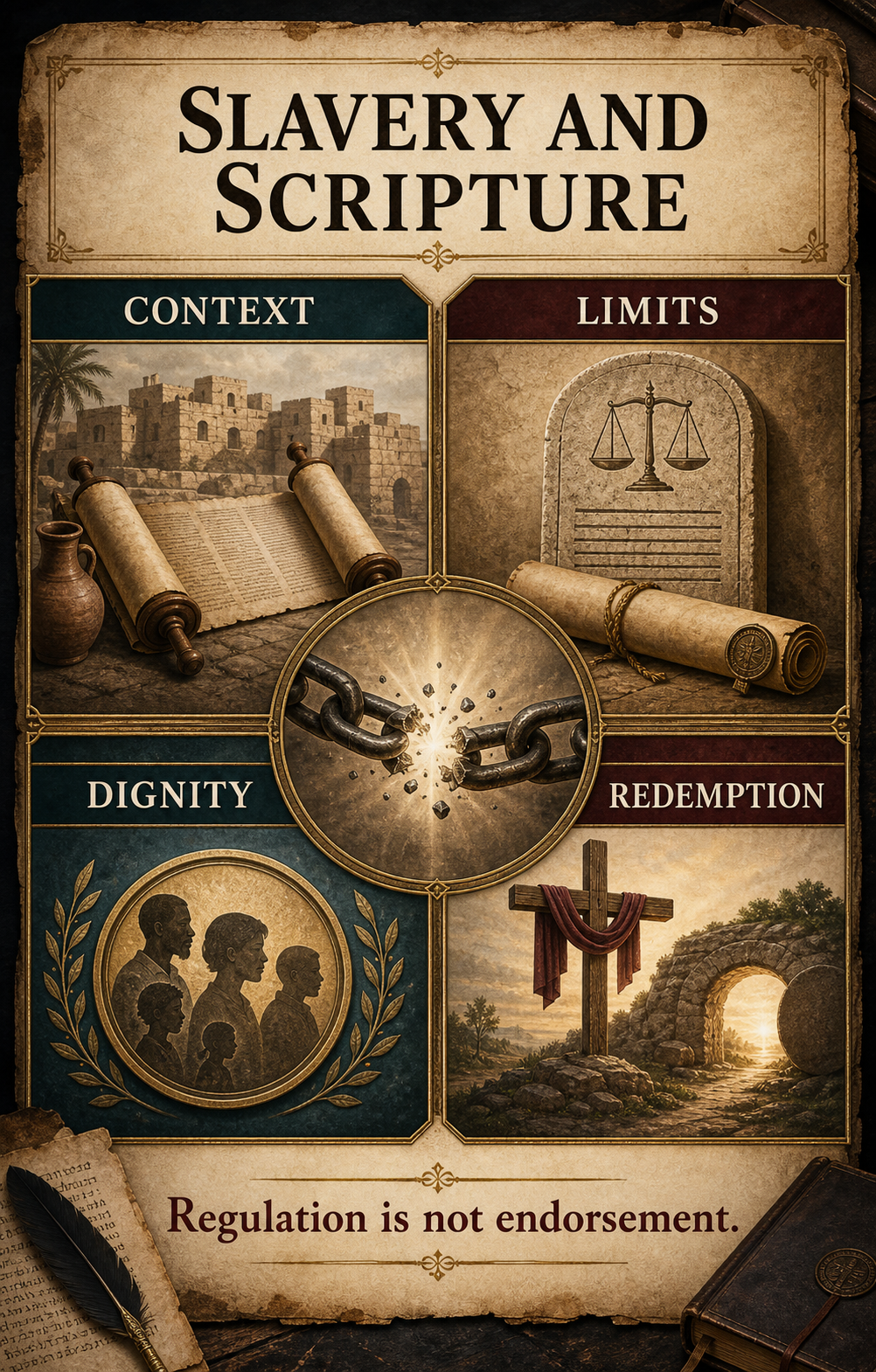
A sober visual treatment of ancient context, limits, human dignity, and redemption.
Do not begin with a dodge. The passages exist, the institution they describe caused real suffering, and “the Bible regulates slavery rather than abolishing it” is an honest sentence, not a trap. A response that sanitizes the Law into a benign apprenticeship will lose a thinking person immediately.
But the objection smuggles in an equation that does the real work: to regulate is to endorse, and ancient servitude is just antebellum slavery in a robe. Both halves of that equation are false, and showing why is the whole task.
The word “slavery” carries the freight of the transatlantic trade; race-based, lifelong, sustained by kidnapping, and treating a person as nothing but property. That is not the dominant picture in the Hebrew Bible, where most servitude was a way for the poor to survive debt in a subsistence economy. A Hebrew servant went free in the seventh year, and again at Jubilee (Leviticus 25), and could not be sent away empty-handed.
Crucially, the engine of chattel slavery; stealing people to sell them, is a capital crime in the Law. Exodus 21:16 and Deuteronomy 24:7 prescribe death for kidnapping a person. Paul echoes it: the vice list of 1 Timothy 1:9–10 condemns “slave traders” (literally menstealers) in the same breath as murderers. The very practice that built modern slavery is the one the Bible says is worth a man’s life.
Honesty still has to face Leviticus 25:44–46 (foreign slaves held long-term and inherited) and Exodus 21:20–21 (the master not punished if the beaten slave survives). These are the texts the objector is counting on, so meet them directly rather than around.
Two things reframe them without explaining them away:
Stand to Reason’s Jonathan Noyes presses exactly this point: the Law was not drafted to justify the institution but to reform it from inside, granting servants rights unheard of in the ancient world.
Underneath the case law runs a deeper claim the institution cannot survive: every human being bears the image of God (Genesis 1:26–27). That is also the foundation of the moral argument, if people have real, equal worth, it is because they are more than property.
The New Testament then lights the fuse. Paul sends the runaway Onesimus back to Philemon not as a slave but “as a beloved brother” (Philemon 15–16). He tells masters they have the same Master in heaven, “and there is no favoritism with him” (Ephesians 6:9). He declares that in Christ “there is neither slave nor free” (Galatians 3:28). A worldview in which the slave is your brother, your equal before God, and your fellow heir cannot keep him as chattel for long. It is no accident that the abolitionists who finally broke the trade; Wilberforce, the Quakers, the freedmen preachers; argued from this Bible, not against it.
Full rebuttal
The moral argument does not claim atheists cannot know or do moral good. It asks what kind of reality best explains binding moral obligation, human dignity, guilt, and moral accountability.
The moral argument is constantly misheard, so state it precisely. It does not claim that unbelievers cannot be good, cannot tell right from wrong, or cannot raise decent families. They plainly can and do. The argument is not about moral knowledge (how we come to recognize right and wrong) or moral practice (whether we live up to it). It is about moral ontology: what reality grounds genuinely binding moral obligations in the first place.
The Stanford Encyclopedia survey describes this whole family of arguments as reasoning from some feature of morality to God as its best explanation. The Christian is not insisting that atheists have no morals; he is pressing a question the atheist must also answer: when you say an act is truly wrong, not just unfashionable or forbidden by your tribe, what makes that true?
Two features of moral life resist easy reduction.
The first is binding obligation. Most people, on reflection, hold that torturing a child for entertainment is not just distasteful or socially counterproductive but really, mind-independently wrong, even if every society came to approve of it. That is a claim about how things are, not about how we happen to feel. A standard form of the argument grants exactly this: there are objective moral facts, and then asks what best explains them.
The second is human worth. We treat persons as having a dignity that does not rise and fall with their usefulness, their power, or the consensus around them. The weak, the unborn, the enemy, and the prisoner each retain a worth that forbids certain treatment. But if a human being is finally just rearranged matter, naturalism has no stable ground for that non-negotiable worth. Christianity grounds it in persons being made in the image of God: a dignity conferred by the Creator, not earned by achievement or assigned by society.
The unbeliever has real answers here, and they deserve real engagement rather than caricature.
The classic counter is the Euthyphro dilemma: is something good because God commands it (then goodness is arbitrary; he could have commanded cruelty) or does God command it because it is good (then goodness stands above God, and we never needed him)?
The Christian answer declines both horns. Goodness is neither an arbitrary divine decree nor a standard hovering above God; it is grounded in God’s own necessary and unchanging character. He does not consult an external rule of love and justice, nor invent one on a whim. He is love and justice, and his commands express what he is. Cruelty was never a live option, because it contradicts his nature.
Here the argument turns pastoral. The same moral law that lets us name evil for what it is also turns and indicts us, which is the honest weight underneath every appeal to the problem of evil. If there is a real moral law, we have all broken it. Christianity does not flinch from that verdict; it answers it with a cross. The God who grounds the law is the God who bore its penalty.
Moral arguments for God's existence form a diverse family of arguments that reason from some feature of morality or the moral life to the existence of God, usually understood as a morally good creator of the universe.
Bottom line
The moral argument never claimed unbelievers can’t be good. It asks the harder question: what makes “that is truly wrong” actually true, and where does the unbudging worth of a human person come from? Instinct, contract, and consensus can explain our moral feelings but cannot ground a binding obligation over us. A morally perfect God who made us in his image can. And the very law that exposes the world’s evil exposes our own, which is exactly why the gospel is good news.
Christian answers should neither overstate what textual evidence can prove nor concede the false claim that ordinary variants erase the Bible’s message. The transmission is well documented, the variants are largely trivial and always identifiable, the apostolic testimony was public, and no central doctrine hangs on a disputed reading.
Reliability does not mean we possess the autographs, or that no scribe ever slipped. It means two things: the message the biblical writers delivered can be recovered with confidence from the evidence we have, and that message rests on testimony open to public examination rather than on a private vision no one else could check.
Granting the first point honestly actually strengthens the case. We are not claiming a miracle of flawless copying; we are claiming that the manuscript tradition is rich enough to correct itself and recover what was written.
Critics rightly point out that the manuscripts contain many variant readings; Bart Ehrman’s popular work makes much of the count. But the same scholarship that catalogs the variants also explains why they do not bury the message:
Even on Ehrman’s own account, the central teachings of the faith are not left hanging on a disputed text. Metzger and Ehrman’s standard handbook treats the goal of the discipline as the recovery of the earliest text; a recovery the evidence makes possible, not a loss it makes permanent.
The Bible’s most important claims are tied to public events and named witnesses. Paul, writing within a few years of the events, hands on a creed he himself “received”: that Christ died, was buried, and was raised, and appeared to named people and to crowds, “most of whom are still living”; an open invitation to check (1 Corinthians 15:3-8). Hebrews opens by appealing to God’s speech “in these last days” through the Son, a matter of public proclamation.
Richard Bauckham argues that the Gospels read as eyewitness testimony rather than free-floating folklore: named figures, identifiable tradents, and the controlled memory of communities close to the events. Whatever one finally concludes, this is the opposite of a secret revelation that cannot be examined.
Jude appeals to “the faith entrusted once for all to the saints”; a settled, shared deposit, not a private possession revised at will. The recognition of the canon was likewise a public, communal process: the churches received the writings that carried apostolic testimony, rather than a single authority inventing scripture behind closed doors.
The meme that asks “which Bible is approved by God?” points to a real but often misused question. Protestants, Catholics, Orthodox, and Ethiopian Orthodox Christians count Old Testament or deuterocanonical books differently. That should be answered honestly. But those differences are not different New Testaments about Jesus. The major Christian traditions receive the same twenty-seven New Testament books, and the disputed Old Testament edges do not create or erase the apostolic witness to the crucifixion, resurrection, and identity of Christ.
This matters when answering claims that the Bible was secretly stripped of “plain and precious truths,” as discussed in the Bible lost plain and precious truths. A public, widely copied, widely cited text is the hardest kind of document to secretly gut.
Muslim critics sometimes press the Bible with a standard they do not apply to the Qur’an: later manuscripts, collection history, named or unnamed human writers, copyist variants, and canon recognition are treated as fatal for Christianity but harmless for Islam. That is not a neutral standard.
The traditional Sunni account does not present the Qur’an as a leather-bound book written by Muhammad and handed unchanged to later generations. Muhammad recited revelations over about twenty-three years; companions memorized and wrote them; after Muhammad’s death Abu Bakr commissioned Zayd ibn Thabit to collect the Qur’an because reciters had died at Yamamah; and Uthman later standardized the text for the provinces and ordered other Qur’anic materials burned. Muslim writers may argue that this process preserved the Qur’an. But then collection by witnesses, post-event writing, human scribal work, and standardization cannot be used automatically to dismiss the Bible.
The qira’at make the point sharper. Mainstream Islam recognizes multiple canonical readings of the Qur’an. Many differences are pronunciation or dialectal, but some affect wording enough to be represented in translation; Bridges’ Translation of the Ten Qira’at says it footnotes the portion of qira’at variation that affects meaning in English. That does not by itself disprove Islam, just as New Testament variants do not by themselves disprove Christianity. It does mean the slogan “our text has no versions while yours does” is too simple. The better question for both books is whether the public evidence preserves the message it claims to preserve.
The strongest objection, developed in the Bible is corrupted, is the “telephone game”: across centuries of hand-copying, errors must have compounded until we can no longer know what was first written.
But transmission is not a single chain whispered ear to ear. It is many independent lines of copying, beginning early and spreading quickly across regions and languages. Because the lines are independent, a corruption in one branch is exposed by the others; there is no single point through which an error could pass undetected to everyone. The absence of the original autographs is normal for every ancient text and does not prevent reconstruction; for the New Testament the evidence is earlier and far more abundant than for any other work of antiquity. The honest conclusion is not “we cannot know,” but “we can identify the disputed points, and they are few and doctrinally minor.”
Bottom line
Biblical reliability is a modest, defensible claim: the message is recoverable and the testimony is public. The manuscript tradition is rich enough to expose its own variants, and the variants that matter are few and touch no core doctrine. Far from a private revelation passed down a fragile chain, the Bible’s central claims were proclaimed in public, tied to named witnesses, and preserved across many independent lines of copying.
The Mosaic Law was not written to justify slavery.
That intrinsic, transcendent value and worth of every human being is undermined by slavery since it causes violence to image bearers.
Why didn’t God just ban slavery outright?
For the same reason the Law permits divorce while calling it less than the ideal; God meets a hard-hearted people inside their history and moves them, rather than dropping a finished ethic on a society unready to keep it. A flat ban on an economy’s basic survival mechanism, with no power to enforce it, would have been ignored. Instead the Law restrains the abuses, criminalizes the slave trade, and seeds the principles; image of God, the runaway protected, the slave as neighbor, that eventually make the institution unthinkable. That is how moral reform actually works on real people.
But Leviticus 25 lets Israelites own foreigners for life and pass them to their children. Isn’t that chattel slavery?
It is the hardest text, and foreign servitude was genuinely harsher than the Hebrew kind. But even here the person is not bare property: kidnapping him would be a capital crime, killing him made the master liable, a runaway could not be handed back, and a circumcised servant shared the household’s Sabbath rest and Passover. It is bounded, not race-based, and not the kidnap-driven trade Scripture condemns. And it sits under a canon whose own logic; culminating in Onesimus the “beloved brother”; works to undo it.
The New Testament tells slaves to obey their masters instead of condemning slavery. Doesn’t that endorse it?
The early church was a powerless minority with no lever on Roman law; calling for a slave revolt would have gotten its members crucified and changed nothing. Paul’s strategy was subversion from within: he condemns slave traders (1 Timothy 1:10), tells masters they answer to God for how they treat their slaves (Ephesians 6:9), and reframes the master–slave bond as a brotherhood (Philemon). He attacks the root; the idea that one image-bearer can own another, rather than only the branch.
Common mistakes
Bottom line
The Bible regulates an institution it did not invent, criminalizes the kidnapping that powered slave-trading, and grounds every person’s worth in the image of God. Its inner logic; the slave is your brother, your equal before God, is the logic abolitionists used to end the trade. “Regulate” is not “endorse,” and the book that condemns menstealers and calls Onesimus a beloved brother is not slavery’s friend.
The objection at its strongest
It is no use pretending the texts are not there. The Law does more than tolerate slavery; it legislates it as a normal feature of life. Leviticus 25:44–46 lets Israelites buy foreign slaves, hold them as property, and bequeath them to their children as a permanent possession. Exodus 21:20–21 says a master who beats his slave is not to be punished if the slave lingers a day or two, “since the slave is his property.” The New Testament never reverses this; it tells slaves to obey their masters and sends a runaway back to his owner.
A perfect, timeless God could have written one line; you shall not own human beings, and spared the world millennia of misery. He did not. So either he approved of the institution, or the book is the work of men who did.
Secondary context
Popular apologetics article answering the objection that the Bible endorses slavery.
Jonathan Noyes, “Is the Bible Pro-Slavery?” Stand to Reason, July 3, 2024, accessed June 16, 2026.
Open sourceReference
BibleRef provides reference material for Scripture passages.
BibleRef, accessed June 16, 2026.
Open sourceReference
Academic reference article surveying arguments that reason from morality, obligation, dignity, or moral knowledge to God.
Stanford Encyclopedia of Philosophy, “Moral Arguments for the Existence of God,” accessed June 16, 2026.
Open sourceSecondary context
Long-form apologetics interview addressing common atheist objections about creation, morality, religious exclusivity, Jesus’ existence, and the resurrection.
Wes Huff, “Wes Huff Debunks TOP 7 Atheist Arguments w/ John Lovell,” The John Lovell Show, Warrior Poet Society, YouTube, November 6, 2025, accessed June 16, 2026.
Open sourceSecondary context
Apologetics video focused on the problem of evil, moral objectivity, the cross, and the already-not-yet shape of Christian hope.
Wes Huff, “Wes Huff Challenged On Christianity’s TOUGHEST Question (Why Evil?),” Daily Dose Of Wisdom, YouTube, February 13, 2026, accessed June 16, 2026.
Open sourceReference
Explanation of the Gregory-Aland numbering system and the cataloging of Greek New Testament manuscripts.
Center for the Study of New Testament Manuscripts, “Manuscripts 101: GA Numbers,” October 24, 2022.
Open sourceReference
Introductory explanation of New Testament textual variants and why many variants are insignificant.
Center for the Study of New Testament Manuscripts, “Manuscripts 101: What Is a Textual Variant?” March 14, 2023.
Open sourceReference
Institute for New Testament Textual Research discussion of manuscript-counting complexity in the NTVMR and Kurzgefasste Liste.
Katie Leggett and Greg Paulson, “How Many Greek New Testament Manuscripts Are There Really? The Latest Numbers,” Institute for New Testament Textual Research, September 29, 2023.
Open sourceReference
Reference work on New Testament textual transmission.
Bruce M. Metzger and Bart D. Ehrman, The Text of the New Testament: Its Transmission, Corruption, and Restoration, 4th ed., Oxford University Press, 2005.
Secondary context
Critical popular work on New Testament textual variants.
Bart D. Ehrman, Misquoting Jesus: The Story Behind Who Changed the Bible and Why, HarperOne, 2005.
Secondary context
Scholarly work on Gospel testimony and eyewitness memory.
Richard Bauckham, Jesus and the Eyewitnesses: The Gospels as Eyewitness Testimony, 2nd ed., Eerdmans, 2017.
Reference
Scholarly reference work collecting and analyzing early Jewish and Christian canon lists.
Edmon L. Gallagher and John D. Meade, The Biblical Canon Lists from Early Christianity: Texts and Analysis, Oxford University Press, 2017.
Primary source
A major Sunni hadith collection presented by Sunnah.com.
Sahih al-Bukhari, Sunnah.com, accessed June 16, 2026.
Open sourceRepresentative source
Muslim apologetic overview of the traditional account of the Qur’an’s collection and Uthmanic standardization.
Ammar Khatib and Nazir Khan, “The Uthmanic Codex: Understanding how the Qur’an was Preserved,” Yaqeen Institute, June 22, 2022, updated July 22, 2024.
Open sourceRepresentative source
English translation project that marks meaning-affecting variations among the ten canonical qira’at.
Fadel Soliman, Bridges’ Translation of the Ten Qira’at of the Noble Qur’an, Bridges Foundation, 2020.
Open sourceSecondary context
Academic study of the transmission, canonization, and classification of Qur’anic variant readings.
Shady Hekmat Nasser, The Transmission of the Variant Readings of the Qur’an: The Problem of Tawatur and the Emergence of Shawadhdh, Brill, 2012.
Open source